Archive for the ‘Sci-Fi’ Category
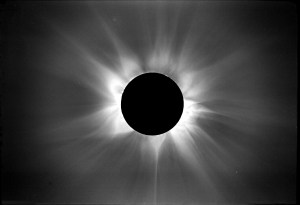
Credit: NASA
There’s a whole lot going on in nature this week. Take, for example, the March 20th total eclipse. It’s the first total for a couple of years. The others have been annular, or the kind where the moon doesn’t quite hide the sun and it peeks out like a ring. And in case you didn’t know, eclipses come in pairs, two weeks apart: the sun hides its face, then the moon. It’s just the way nature works. Not everyone gets to see this spectacular event; those in the northern extremes of Europe (and polar regions) will see it just fine, but the rest of Europe will have to settle for a partial eclipse. That’s fine by me, something is better than nothing.
Eclipses are weird. I experienced a total eclipse when I was about 7 or 8 years old. It was covered live on TV, when people still held wonderment and what nature could do. I clearly remember it got dark, a fairly good representation of the stars came out, birds went silent and all became still. Mom admonished me for looking up at the sky, yet both of us snuck a peek and I remember getting a chill. It was so, so strange to see this blackness where the sun ought to be. Lots of our neighbors came outside and pointed and laughed nervously. We all knew better. We knew that the sun’d pop back out again and the warmth would return, birds would wake up, a bit confused at the short night, perhaps, but ready to launch into song once more. And sure enough, it did. Everyone retreated to the inside of their houses, catching the few last bits of the broadcast describing the marvel we all experienced.
So what if the sun got stuck, though, behind the moon? Suppose, just for an hour or two, the sun had had enough of working to warm the planet. The moon, normally a celestial object waiting to dominate the evening sky, chose not to budge, either. Let’s say they went to war. A line was drawn in the sky, and neither of them were giving way until the other relented. Imagine what people might say then? Oh, they’d be all right with it for about the first five or ten minutes, but after that? A nip in the air becomes a chill, then cold, then freeze. Our balance turns wobbly, then a sickly feeling emerges from our insides. Hair rises off of our heads as breezes end. Building creak, water flows everywhere and electricity shorts out. Planes can’t fly. Our world ceases, but still exists. The National Guard is called out, but is helpless against the force of nature.
Take that, Nature says, and keep on ruining the planet. I’ll take care of matters for myself. When all of you have had your fill of ignorance, I’ll imbue you with light. Until then, may the best people evolve, while I clean house.
Ah, if only…
In the meantime, we’re still here, facing the Ides of March, Pi Day, and the inevitable East Coast first day of spring snowstorm from the relentless winter we’ve been experiencing. Can’t wait to shovel that 3″ – 6″ in the driveway.

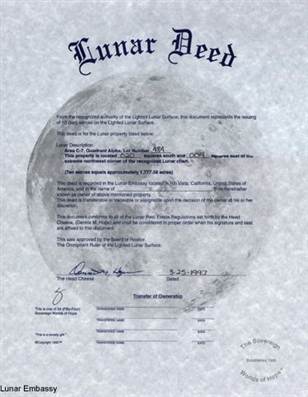
Credit: Lunar Embassy
This sort of thing has been going on for seemingly ever – real estate for sale that’s basically unobtainable – but it’s never stopped anyone from trying and believe it or not, it’s a profit-making enterprise.
Take, for example, LunarLand.com. Since 1980, they’ve been selling offworld prospectors lunar property one acre at a time. And why not? Just about everyone, and I mean everyone, has endorsed them. A quick trip to their website tells you that over 250 celebrities have snapped up lucrative tracts of land, perhaps one day to start a development bearing their name.
It’s not like it’s a great wad of dough you have to shell out, either. For $29.95, you too can lay claim to a spot of your own, and it comes complete with all the documentation you’ll need. So if some pesky astro-, cosmo- or taikonaut trudges through the breccia on your spot, you have every right to give them the boot or charge rent.
So how is this possible? Well, in 1967 a treaty stated that governments can’t own lunar land, but there’s nothing to stop corporations and private individuals from doing so. All property sales are registered with the US Office of Claims Registries, the same office that’s responsible for any land claims. Any government in the world is free to challenge this, but so far, none has.
But is it realistic? Can you really hop in your own rocket, blast off and set up housekeeping/shop in a barren world with little means to support yourself in any way, shape or form?
Ah, that challenge was faced by those intrepid souls who once trod the lands of this country back in time, not knowing what they’d find or if they’d survive the experience. But somehow life carried on, the land was settled and people prospered. Houses were built, highways grew and shopping malls sprang up like crocuses in spring.
So, what are you waiting for! Grab your lunar acreage while the opportunity’s still fresh!

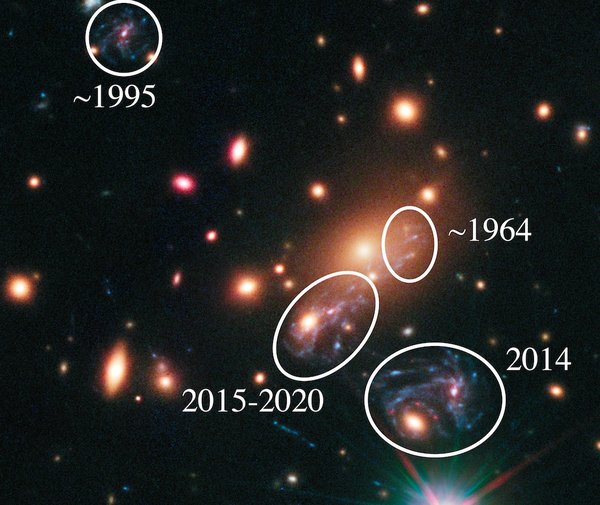
Multiple images of the Supernova Refsdal, appearing over time. Credit: NASA and European Space Agency
There’s a sight to behold in the universe, located in the constellation Pegasus. It’s known as the Einstein Cross, a singular supernova that is seen four times. It’s an example of the forces of time and gravity meeting in space, and what can happen when they dance together.
Simply put, the Einstein Cross is the result of gravitational lensing. That means there’s something in the way that’s spreading the view. Take, for example, one exploding star. Place in front of it a collection of galaxies. The gravitational force is such that the rays of light are spread in several different directions, and in this case, four. So while it’s rare enough to catch a star exploding, it’s even more magnificent to watch it four times.
The New York Times has a great article and a very cool video regarding this unique occurrence in the universe. You can read it here.

In case any of you are wondering where you could get yourself some new, cheap and quick sci-fi reads to load on that new iPad or tablet you got for Christmas, your birthday or just for fun, have I got a link for you!
Check out Wattpad, a site dedicated to new, established and undiscovered writers of all genres, but also for science fiction. There are literally hundreds of books to choose from, on a wide range of topics. If you’re searching for the latest in alien lit, or want to bone up on mysterious plagues or merciless wars, here’s your chance to follow serialized books. What’s also great about this site is it offers writers, both established and new, the opportunity to create and share their work.
By the way, it’s not just for sci-fi fans – it’s for everyone. If you want to sink into a romance or inform yourself on a particular topic, even catch the latest on werewolves and vampires, it’s all there.
But that’s not all, folks…there’s more!
Thinking of a good story and searching for a place to put it down into words? This site also allows you to create. There’s no demands on writers who wish to launch their careers, nothing to sign, no rights to control, no promises to turn over your firstborn. It’s a direct connection to 30 million readers worldwide who might just sink their teeth into your mysterious fantasy and become an ardent fan. It’s better than a blog, it’s your work!
If nothing else, this is a good site for those who might need a bit of encouragement to start placing their thoughts into a real work. Someone’s bound to trip over what you’ve written, and you’ll get a real chance to have others examine your work. Sure, it might be scary, but it’s also helpful. Think of it as a growing process, and you’ll be on your way publishing that great story you’ve been dragging around in your head.
So what are you waiting for – get writing!

Farewell, Friend…
I heard he had gone into the hospital, but who’d ever think that Spock would die? That’s as unfathomable as space and time itself!
Spock…dead?
People of a certain age, such as myself, count their youthful years against the number of Star Trek episodes they identify with. I was quite young when they originally aired, but I remember seeing them. Later, in the 1970s, Mom always turned the show on after dinner. And there he was, Spock, spouting his quiet but firm logic against the perpetually angered and impulsive Kirk. He had a better grip on things, from his unique perspective. Half human, half Vulcan, he read into Earthly beings with insight, yet allowed his mature, tamer side to pump out the decisions that allowed the Enterprise to stay afloat in space.
So why wasn’t he the captain, you ask?
No swagger value, I’m afraid. A quiet, contemplative fellow, Spock chose to pursue feats of the brain instead of the brawn. And that’s fine, really. There’s too many jocks out there, and every braniac, nerd, geek and other reject embraced Spock with a passion, because it gave them a great model to follow. No, you don’t have to be a football player or a cheerleader – the universe needs thinkers, too!
In middle and high school, the same geeky types that were into Star Trek were also into such shows as Dr. Who and Space: 1999. Even Monte Python’s Flying Circus. We were the group that got all the strangeness because we didn’t have to worry about what people thought of us – they already thought we were weird. Our imaginations set us free, launching us into the stratosphere with odd concepts convincingly plausible. I got a bit stuck on wondering just exactly where in the universe the Enterprise was located, or headed. How come they never ran out of gas? Or water? Or food? Where did they get their uniforms from? Who did the laundry? How did they maintain personal hygiene? I figured a ship that size had to have an awfully large cargo bay. Maybe they did purloin provisions from populated planets.
My college friend Linda probably had some insight into these issues. She devoted her life (at that point, anyway) to two things: music and Star Trek. She memorized each episode, completely down to the credits. She possessed an actual female uniform and wore it when the occasion demanded it. Without hesitation she could name any tiny bit of trivia one threw at her, often showing down many a Star Trek scholar – which she proudly was – often at the price of a beer.
Still, this iconic sci-fi show would be nothing without its iconic star. Spock beckoned us to live long and prosper, which he surely did. He leaves us to enjoy the episodes which made him famous and live long in our hearts forever.

Time. Space. There’s an awful lot of it. The two are a married couple, together for eternity, destined to rule everyone’s ultimate fate but perhaps their own. What is all that out there, anyway, and how did it begin?
As I drove to work yesterday, whiteness blanketed every surface, including the river I travel along. The snow disguised every surface, shrouding shapes. It almost became difficult to see where the river and its banks met. Where did one begin and the other ended. For one reason or another, my mind drifted to the endless void of space. You know, the one that’s situated where our planet and its eight companions hang out.
Sure, there’s loads of theories detailing how the Big Bang began it all. But what prompted it? And where, exactly, did that bang occur? What was the situation, the circumstance, the one moment where conditions were correct to unleash a tide of matter and send it forth for eons? Say, now’s a good time to create…everything…
Again, there are theories about all of this. Tracing the creation of the universe to that Big Bang is pretty much where it stops. My curiosity lies with What Came Before.
In my opinion, some matter had to be gathered together initially to agitate enough to explode. What created that matter and how much was there of it to launch forth an entire universe of galaxies, novas, quasars and planets? What created the void wherein the matter floats and drifts? And like any explosion, the shock waves fly out until they dissipate or crash against a solid surface. Will the shock waves act as ones that dissipate or like a string on a yo-yo, reaching a limit and then curl back?
It’s a lot to ponder as one’s listening to the band Viet Cong play “Silhouette” on the car radio, driving past a white ribbon of frozen river.
Just to perplex myself even further while I crossed over a bridge, I thought about the time it took to accomplish all of this. No, not the kind of time-bending that Einstein and the movie “Interstellar” explored. Just a simple answer. You know, like 30 billion years. Or so. And how long did that void exists before it decided to make a universe? What came before that? And that?
I arrived at my destination: a small museum that I run. Out of time, I pulled into a space and parked the car. Slipping the key into the door and turning off the alarm, I turned my attention to the matters that awaited me at work, taking satisfaction that there were few mysteries there. Nothing I couldn’t solve, anyway.

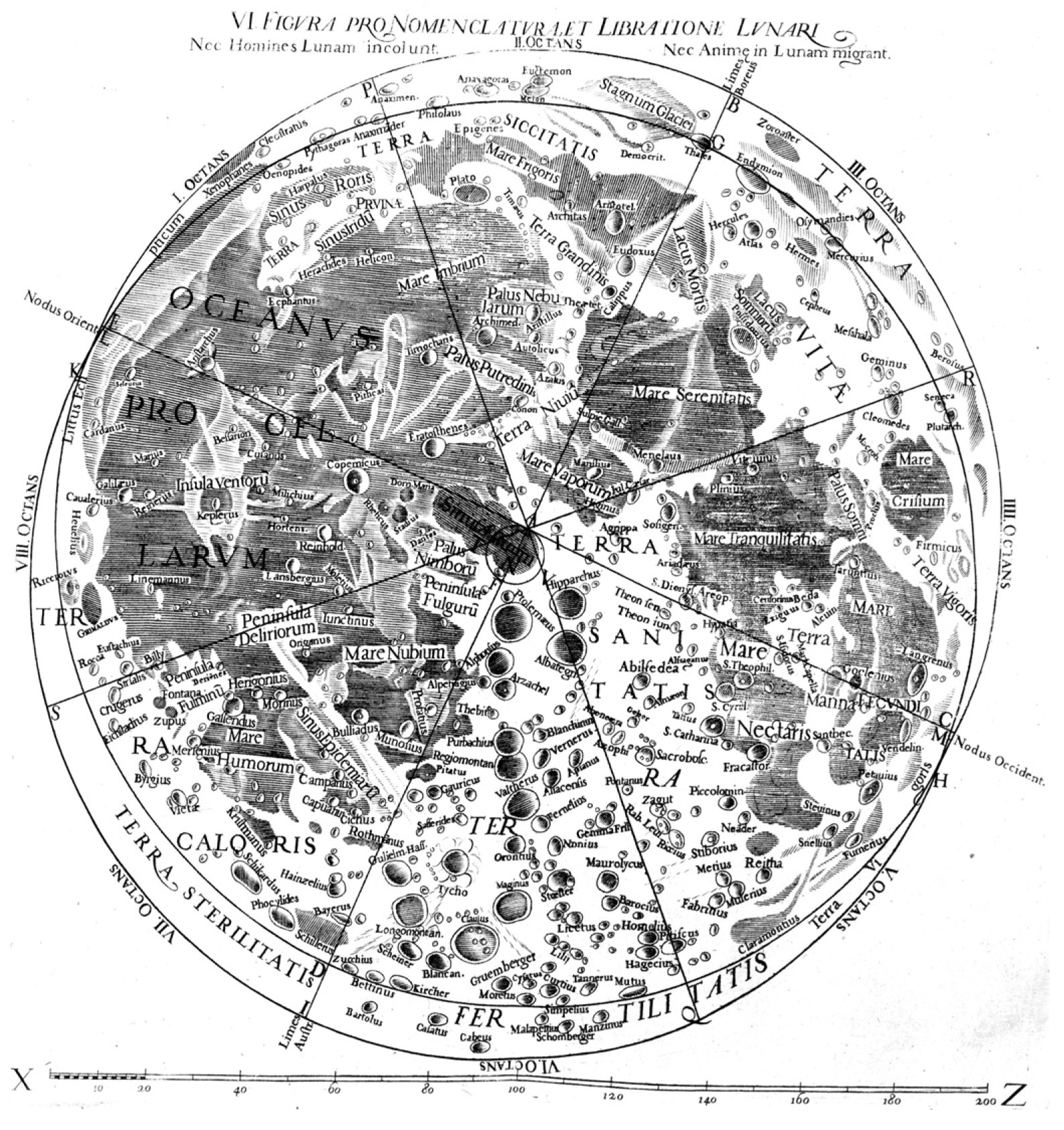
“Riccioli1651MoonMap” by G. B. Riccioli – Almagestum Novum
It used to be a common joke, once upon a time: selling a naive sucker the Brooklyn Bridge. Same goes with swamp acreage. But the moon?
Con artists throughout time dreamt up plots to sell lunar land as expansive as the graveyard along the Garden State Parkway. Don’t worry about how you’re going to get there – you’ll figure it out! Where else can you get so much prime real estate? Tell you what, it’s yours for the price of $100!
Well, there’s organizations selling star’s names to people willing to shell out money for no real reason except vanity – the National Star Registry, for example – but how real is that? Turns out, there’s interest in developing what the moon’s got to offer, and it could possibly be open to anyone with a way up and back.
Before that happens, though, there’s a few important details to consider, starting with the Outer Space Treaty of 1967 (also known as the Treaty on Principles Governing the Activities of States in the Exploration and Use of Outer Space, including the Moon and Other Celestial Bodies). Simply put, it says the moon belongs to no one in particular but to all humankind, no nation can put weapons of mass destruction upon it, and any nation that places a space object that lands upon it is responsible for any damages caused by said object.
This treaty was created well before the concept of private concerns launching their own scientific/lunar endeavors into space. But we’re entering a new stage of space conceptualization now. Private industry is poised to take over where nations once ruled. Corporations such as SpaceX already contribute to NASA missions. So what’s next? The Moon Treaty of 1979 clearly states that no private entity can profit from the moon, and whatever is reaped from the moon must be for the benefit of all. The United States, Russia and China, as well as many other nations, never signed it. While there’s no underhanded endeavor to plunder the moon’s riches currently underhand, anyone’s a fool to think that isn’t going to happen as soon as it’s possible.
And really, what’s to stop individuals from going on up and taking what essentially is ungoverned land? Think about it. Throughout the history of the Earth, nations have taken over other nations, usurped the powers of other leaders, raped the resources and ruined cultures, all for the sake of greed and profit. The entire side of the globe where I live (the United States) can thank its present existence to explorers from the other side of it, all in the name of seeing what’s there and what can be done with it. Never mind that the land was already populated and doing well enough.
Truly, it’s only a matter of time before honest lunar endeavors turn into questionable ones. In my mind, it’ll begin as an entirely cooperative gesture with clearly drawn lines. But in the end, a small incident will lead to greater dissatisfaction, and it’ll only be a matter of time before hell will break loose.
In the meantime, enjoy the view. It might change dramatically during our lifetimes, or those of our descendants.

February 2 is a big day for a small creature. Lots of pressure rests upon the back of the above pictured groundhog. And yes, while he’s enjoying the lovely spring weather in the tree in our backyard, a lot depends upon his interpretation of when that season arrives.
Since it’s really not fair to pin the entire nation’s forecast on one groundhog, many locations throughout the United States and Canada have their own local weather hog. Their names usually reflect their hometowns, such as Punxutawney Phil (from Punxutawney, PA, where the movie Groundhog Day was set), or Staten Island Chuck (from Staten Island, NY), Balzac Billy (from Balzac, Alberta), Queen Charlotte (from Charlotte, NC) or Winnipeg Willow (from Winnipeg, Manitoba).
If it’s a cloudy day and the groundhog doesn’t see his shadow, it’s an early spring. Should that sun be blazing away in the sky, well, that’s enough to discourage any groundhog from enjoying the weather and so our rotund rodent friend retreats to the burrow. Counterintuitive? Yeah, I think so. I mean, why would anyone beat a quick exit from the sun unless they forgot their sunscreen?
Since I’m in the Hudson Valley, I generally take my predictions from Staten Island Chuck. I seem to remember there being a closer chuck, but I didn’t happen to hear what his prediction might be for spring, so I’m sticking with SIC. Seems that he called for an early spring and went back inside. Or maybe he was a bit reticent in making any sort of prediction. You see, last year New York City Mayor Bill DeBlasio was invited to participate in the ceremony and held up the woodchuck/groundhog for the first time. Upon holding said animal, it wriggled from his grasp, fell, and died a few weeks later. This year? Bill watched.
But really, I’d have to say I agree with what SIC predicted. It seems like we’re on a Monday snowstorm schedule. For the past few weeks, we’ve had snow, and just enough to close the schools and prevent me and Andrew from driving to work (but not from our desks at home). It refuses to snow on the weekends, or if it does, it’s on Sunday evening when we’re attentively watching Downton Abbey. The last thing I’m wondering is how I’m going to get to work, it’s how anyone finds Mary so fascinating when she’s got to be the least passionate, sex-craving person on the planet, and yet she attracts men in droves (it’s the money, surely).
I digress.
There is no weather science behind the groundhog, nor do they receive any special instruction from their elders that bestows upon them all the magical powers they’ll need to tell us to go get more salt for the driveway and gas for the snowblower. It all came from a European tradition involving a badger. Pennsylvania Germans began their tradition here in the eighteenth and nineteenth centuries, with the first recorded prediction noted in 1841 from Morgantown, PA (he didn’t say what the groundhog thought about the weather, but I’m sure it wasn’t positive).
As far as I can tell, I’ve not seen any official recognition by the National Weather Service regarding the predictions of any of this nation’s groundhog prognosticating teams. Given the nature of some of their recent predictions, however, one might think they’ve consulted Staten Island Chuck to see what his take on those clouds moving in from the south and east mean.
I’m going with SIC’s prediction for now: six more weeks. After all, we’re expecting 6-12 inches come Sunday into Tuesday.

As one who pays attention to these things, there are always topics and trends that crop up in science fiction that capture imaginations and remain hot for years.
For starters, let’s say anything to do with computers – a perennial favorite.
It seems the moment someone figured out how to put information into a machine and expected a result from doing so launched an endless parade of stories. You got hacking films (take, for example, “Sneakers” to “Blackhat”), unfortunate, misleading games turning out to anything but innocent fun for kids with big ideas and little life experience (“War Games,” “Enders Game”), and even computer-generated lives influencing mortal ones (how can anyone forget “Max Headroom”?).
I’m guessing computers/computing kind of puts you in charge of the story, in a way. As a writer, all one has to do is invent a directive without actually writing one for real. So of course your story can have the main character develop a fantastic method of convincing every single stock broker in America to hand over 25% of profits and deposit the money in a Geneva bank, without question, just by writing a simple, foolproof code. Then the main character goes off and gives all the money to charity instead of living high of the hog. Now that, folks, would be real science fiction, because nothing like that ever happens in real life!
Other perennial favorites sci-fi topics (but not limited to) include:
- Aliens attacking the Earth
- Attractive aliens seducing Earthlings and making them do things (good and bad)
- Human-looking people cavorting with otherworldly beings (and what category do they fit in?)
- Nuclear accidents and other holocausts
- Earth going bye-bye
- Interplanetary hijinks and death battles
- Every sort of space station on every kind of planet, moon and subspecies of galactic existence having issues of some sort
- Weather (Earth and elsewhere) having a mind of its own
- Time/space travel and its consequences (good and bad)
- Beings simply not getting along and the often unfortunate circumstances that arise from said conflict
- Brains – you name it
The mind has a reputation for possessing a fertile imagination. I’d like to think I’m pretty good at dreaming up stuff. I’ve had this blog for nearly a year and I kind of pinch myself when I notice how much I’ve managed to spew out. And yeah, some of you might notice I started two chapters of a book on this site and left it alone for ages – sorry, had other things going on – but I’m not done there, so don’t worry. So I’m putting together a list of topics I really haven’t seen any serious sci-fi author tackle yet. Yes, I might be mistaken, and maybe I haven’t read the right books yet (and there is an endless supply of those, too), but here’s kind of a wish list for topics I’d like to either read or write about someday:
- Brussel Sprouts and Liver – Moms terrorize children the planet over, forcing them to eat food they hate (vegan/vegetarian options welcome)
- The Anti-Text – A 17-year-old girl has to live a full hour without her cell phone…and survive
- Game Over – Professional gamers have to make do with “Pong”
- XT/AT – Present-day programmers scramble to get work done with only 10/20K of memory and have to use Sideways to print their spreadsheets
- Ink Link – Tats jump off of everyone who has one and take over the world, with both disastrous and comical results
- We Get It – Men and women understand each other perfectly and respond to each other’s needs and wishes without fighting over who’s right or needier
- Nice Day – The confusing, unfortunate results of continued pleasant weather, good-mannered people, well-paying jobs and general happiness
- Netscape – People discover this is the only browser available and have only the “Surprise” button to use, and so experience wacky, madcap misadventures
- Wait for No One – Serving staff goes on strike, coffee ceases to exist, coffee isn’t served anymore and the populace winds up jittery, angry and bitter
- Misidentified Fruit – People mistakenly ingest innocent-looking but suspicious-behaving fruit and wind up encased in rock-heavy cakes everyone rejects when served up during the holidays
Anyway, I could go on.
What would you add?
Underserved topics of sci-fi, unite!
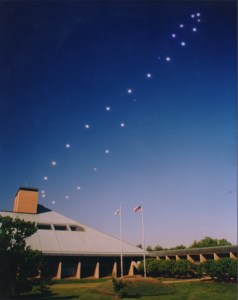
Afternoon analemma photo taken in 1998-1999 by Jack Fishburn in Murray Hill, NJ. Bell Laboratories building in foreground
Have you ever noticed in the mornings, from about mid-December to around mid-January that the sun rises the same time every day? Even though the time of the setting sun changes, the dawn keeps breaking at 7:21 am (or whatever time your sun happens to rise, depending upon where in the world you live). It’s as if it’s stuck, needing an extra nudge to get it moving. Once again, from about mid-June to mid-July, the same thing happens with the sun once more.
As illustrated in the photo above, this phenomena is called an analemma. The Merriam-Webster dictionary defines it as, “a plot or graph of the position of the sun in the sky at a certain time of day (as noon) at one locale measured throughout the year that has the shape of a figure 8; also : a scale (as on a globe or sundial) based on such a plot that shows the sun’s position for each day of the year or that allows local mean time to be determined.”
So, if one were to take a picture of the sun at the same time every day, from exactly the same position, you’d more or less wind up with a figure 8. It’s proof that the Earth’s axis is tilted at 23.439°. However, the angle at which it’s seen changes wherever one is located on Earth. The above was taken at roughly 40° north. Here is a picture taken at Veszprem, Hungary, which is latitude 47°:

Image Credit & Copyright: Tamas Ladanyi – Analemma 2011 – taken at 9:00 am
So at 47°, the sun’s angle’s a bit sharper.
Here’s an excellent link from the Washington Post that illustrates how the sun moves in the sky through the months.
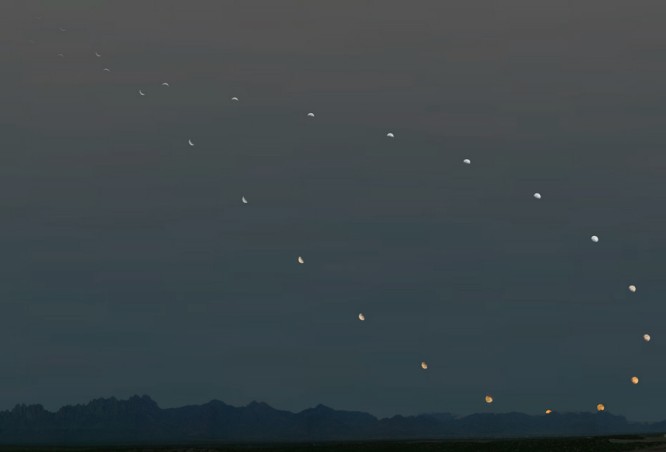
And who can forget the moon? Since it rises and sets, it too creates its own analemma. However, the moon rises 51 minutes later every day, so in order to successfully photograph it, one has to take that into account. Understanding that means the moon returns to the same position 51 minutes later, in accordance to its rising. Still, with patience, one can create an excellent example of what the moon can do, although one has to also remember it has phases. That creates a wonderful variety of shapes. Here’s an example:
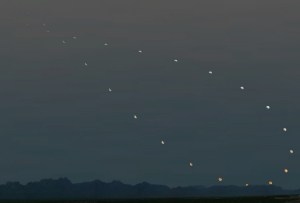
Credit & Copyright: Rich Richins
Earth isn’t the only place where the analemma occurs. Any planet where the sun shines also shares this perspective, although it’s teardrop shaped on Mars:

Digital Illustration Credit & Copyright: Dennis Mammana (Skyscapes)
Why the different shape? Here’s the explanation from NASA:
“On planet Earth, an analemma is the figure-8 loop you get when you mark the position of the Sun at the same time each day throughout the year. But similarly marking the position of the Sun in the Martian sky would produce the simpler, stretched pear shape in this digital illustration, based on the Mars Pathfinder project’s famous Presidential Panorama view from the surface. The simulation shows the late afternoon Sun that would have been seen from the Sagan Memorial Station once every 30 Martian days (sols) beginning on Pathfinder’s Sol 24 (July 29, 1997). Slightly less bright, the simulated Sun is only about two thirds the size as seen from Earth, while the Martian dust, responsible for the reddish sky of Mars, also scatters some blue light around the solar disk.”
Each planet, given its north-south axis tilt and shape of its orbit, has its own analemma shape:
- Mercury – nearly straight line
- Venus – ellipse
- Mars – teardrop (as illustrated above)
- Jupiter – ellipse
- Saturn – figure 8, but with tight northern loop
- Uranus – figure 8
- Neptune – figure 8
Let me add that you don’t necessarily need a camera to record the sun’s analemma. Think back to the movie “Cast Away” wherein Tom Hanks marks on stone where the sun travels throughout the year. You can make note by just looking out the window and the same time each day, seeing where the sun happens to be at the same time each day. It’s pretty cool. Try it!









 Moon, Stars and Beyond
