Archive for the ‘Writing Science Fiction’ Tag
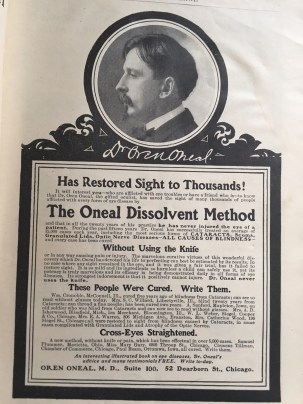
Miracle Man, Dr. Oren Oneil
Since it’s been a while since I did anything remotely steampunkish, I thought I might revisit the genre. I have some old magazines from 1902 – Pearson’s and The Smart Set. As I leafed through the pages, inspiration beat on my brain with the force of a brass Thor’s hammer.
Classifieds and advertisements from bygone eras area always fascinating to read, but none more so, it seems, than from late Victorian/early Georgian era. As technology grew, so did claims about its abilities. While it’s true significant gains in medical research grew during this time, so did quacks who claimed to have the answer for particular ailments.
Take, for example, Dr. Oren Oneil, inventor of the Oneil Dissolvent Method. This convincing ad practically screams credibility, claiming this gifted oculist restored sight to thousands – even cross eyed people! – yet a child could consume his potent tonic and live to talk about it. And if you didn’t take his word for it, just write to the people he cured. But of course, it really was too good to be true, and the truth was exposed in this Collier’s Weekly article from 1906.


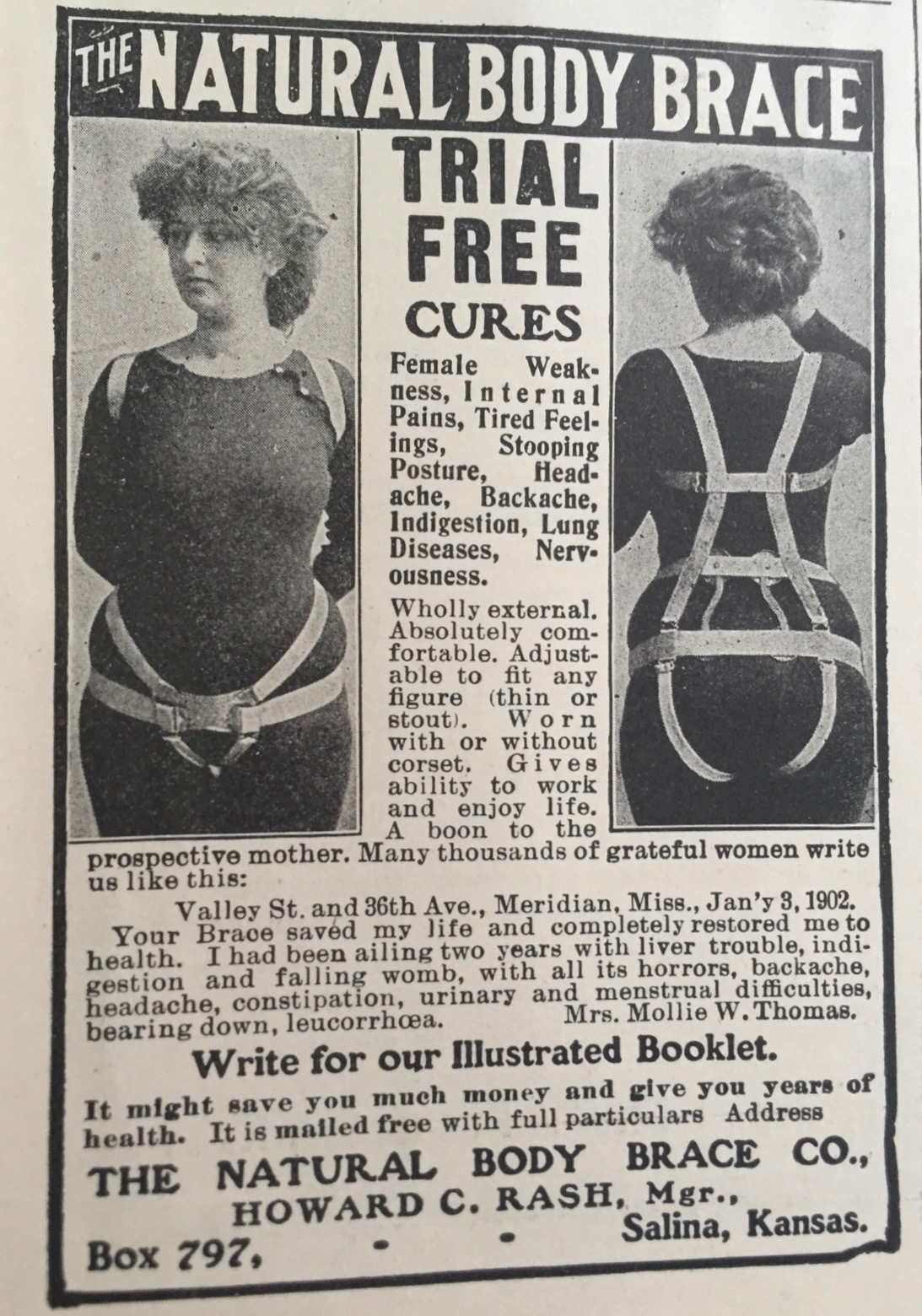
I’m sorry, but there’s nothing natural about these body braces. I can’t help but love the claim, “Cures ailments peculiar to women” and “Female weakness.” How can a gizmo such as the above help with liver trouble, lady’s headache, constipation AND make you more attractive? I do think this body brace would make an excellent addition to any modern-day steampunk costume and peculiarities collection.
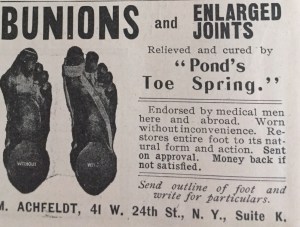
Adding to the brace field is “Pond’s Toe Spring.” This medical marvel has been endorsed by medical men here and abroad, although it doesn’t specify what kind of practice or nation so hot on using said toe spring. I imagine those with foot fetishes go for this sort of bondage thing.

While Dr. Oneil used a tonic to cure blindness and other eye ailments, the marvels of electricity proved a more effective cure. All you needed to use was a pocket battery to remove stubborn cataracts, pteryglums, granulated lids to restore vision. I’m not quite sure why the New York & London Electric Association chose to do business from Kansas City, Missouri, but perhaps it provided a friendlier environment for stealing people’s money.

At first glance, one can hardly guess this is an ad for fake coffee, but a cry for help for addicts of caffeine. Dyspepsia, weak heart, kidney trouble, sour stomach, inactive brain and nervous prostration. While there might be an argument for a few of the ailments, I’m addled to consider blaming coffee on an inactive brain. Who hasn’t gotten juiced up on coffee studying for finals to wake that brain up? Postum, the “food coffee,” is the miraculous cure for those who are hopelessly addicted to the pre-Starbucks set. My own mother used to drink Postum, and I can tell you the last thing it tasted like was coffee.

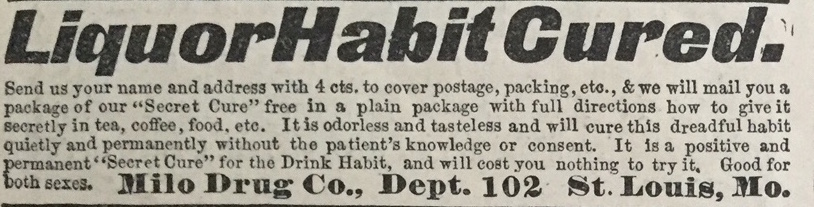
But then again, coffee might not be so bad when you can secretly slip in an odorless, tasteless cure, quietly and permanently without the patient’s knowledge or consent, to cure that evil liquor habit. Sure, because they’ll be dead. At least it’s good for both sexes.
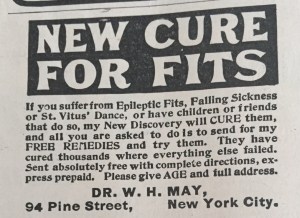
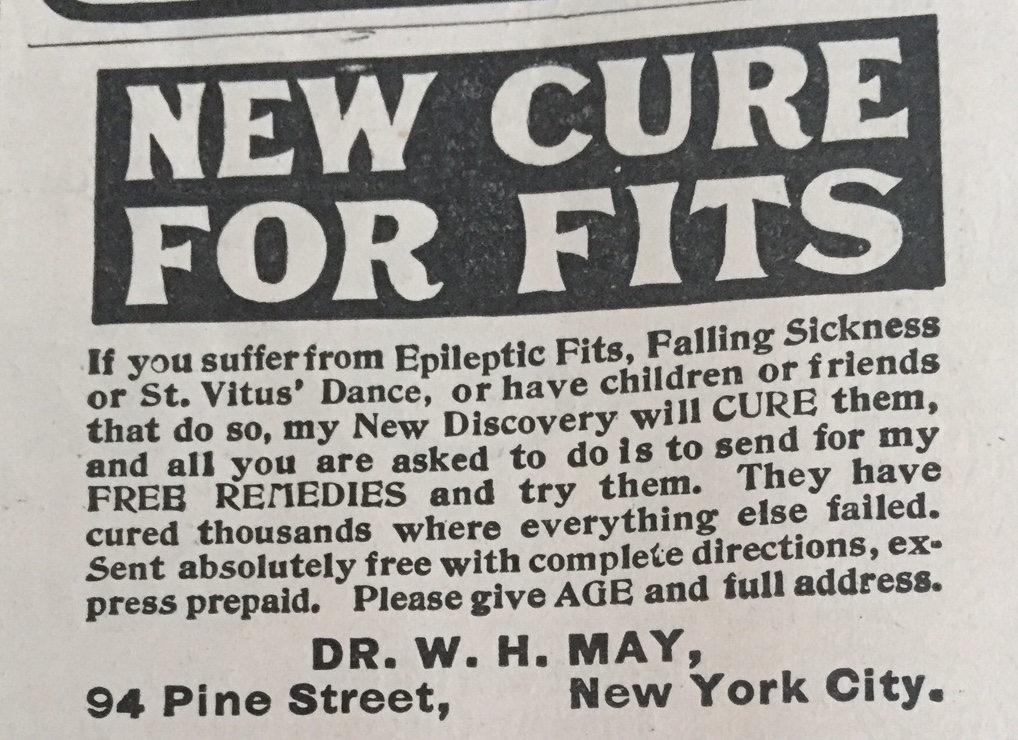
Sure, I’d love to cure my St. Vitus’s Dance, even for free, especially since thousands have been helped where everything else has failed. So now that you have my AGE and full address, what else are you going to rip me off for?
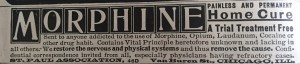
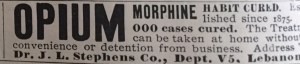
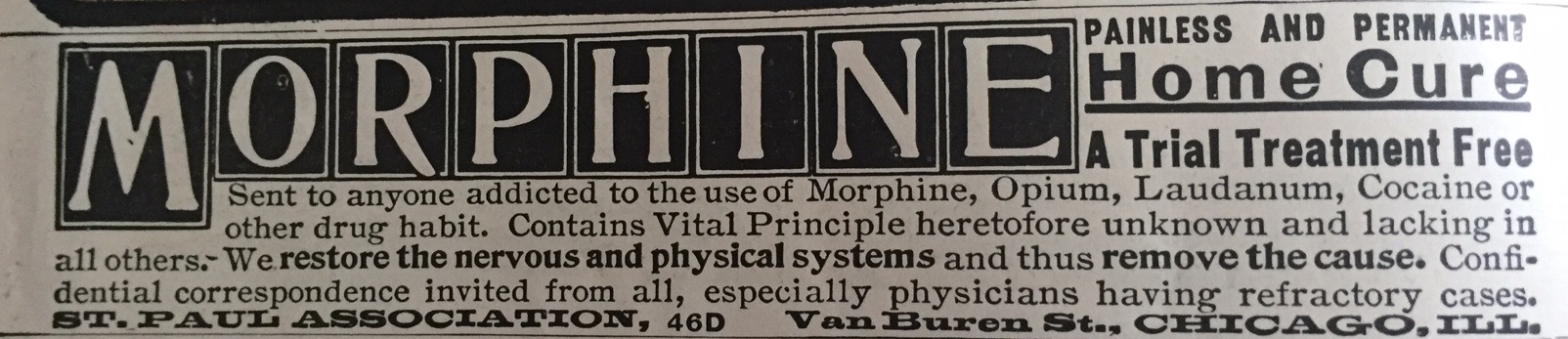
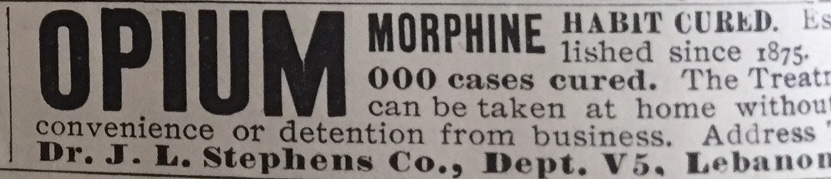
Painless and permanent home cures seem to be the thing. These promise Vital Principle heretofore unknown and lacking in all others, and better still, can be taken without interruption to convenience or detention from business. Again, I’m thinking this is possible because the distressed addict will die, leading to the permanent cure.
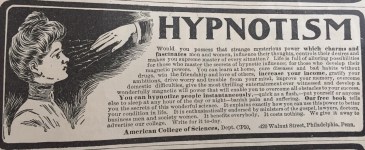
The general rule is: if it has buzz marks, then it’s effective. The ad says, ” Life is full of alluring possibilities for those who master the secrets of hypnotic influence; for those who develop their magnetic powers. You can learn at home, cure diseases and bad habits without drugs, win the friendship and love of others, increase your income, gratify your ambitions, drive worry and trouble from your mind, improve your memory, overcame domestic difficulties, give the most thrilling entertainment ever witnessed and develop a wonderfully magnetic will power that will enable you to overcome all obstacles to your success.” What hooked me was: “It is enthusiastically endorsed by ministers of the gospel, lawyers, doctors, business men and society women.” Think about this combination. Doctors trying to get over on people need lawyers so they don’t get sued for using newfound powers on society women who presumably will become fallen women who need to be saved by ministers of the gospel. That’s just my take on it.
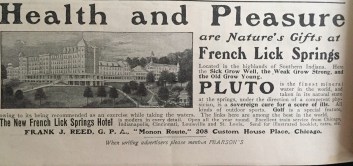
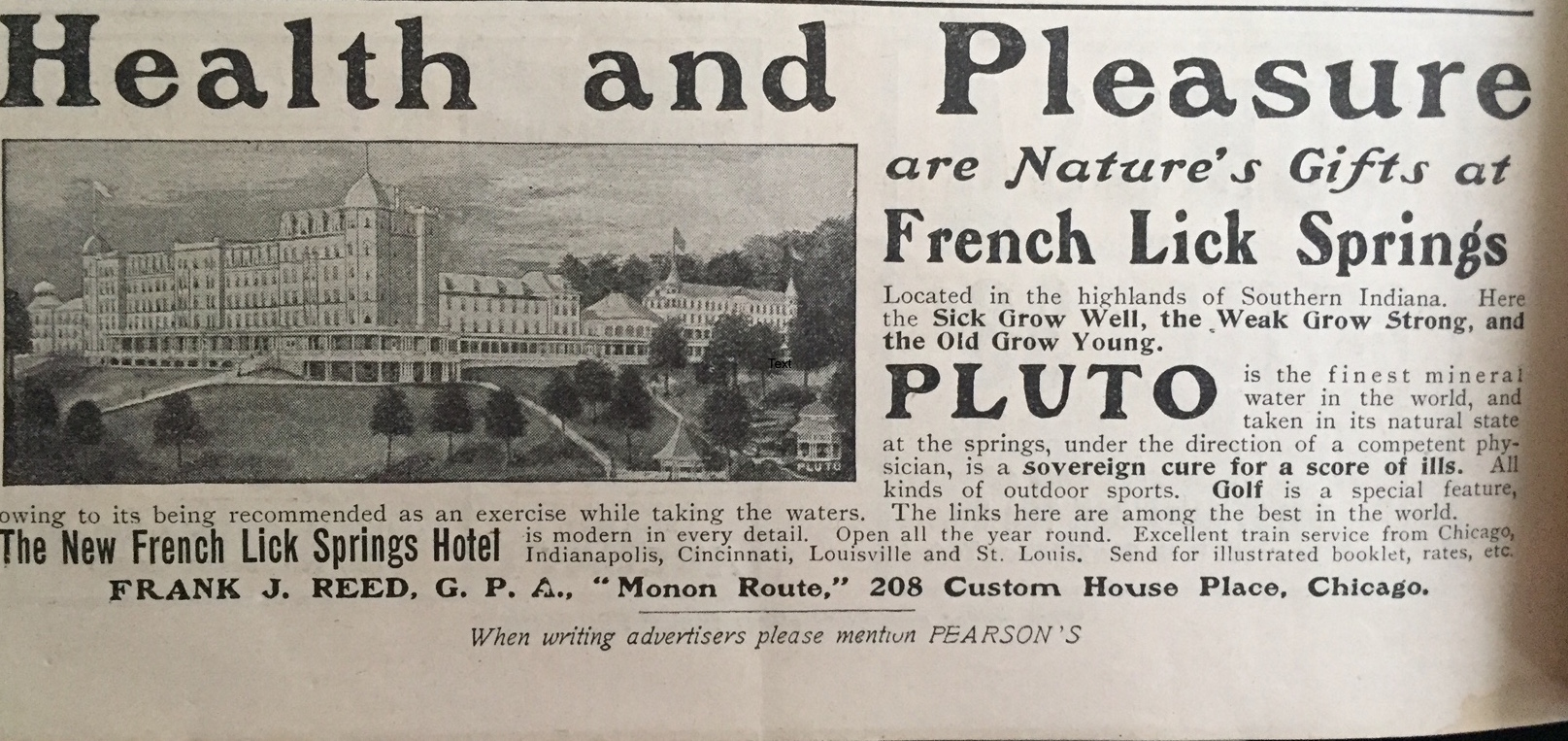
Of course, all of the above can be had for the price of admission at French Lick Springs. It’s the capital of pleasure!
Bon voyage!

Photo credit: ft.com
They say if you stick a bunch of typewriters in front of a roomful of monkeys, they’ll eventually churn out Shakespeare. Now, I’ve never seen that proven but here’s a fact: artificial intelligence is now composing prose.
I like to read Engadget . It keeps me updated on technology of all sorts, no matter who or what developed it. So a story caught my eye the other day: AI-written novel passes first round of a literary competition. This competition, taking place in Japan, marked the first time an AI-human collaboration garnered serious consideration.
The Hoshi Shinichi Literary Award opened up its competition to artificial intelligence for the first time this year. Out of 1450 submission, 11 were human/AI collaborations.
Now, it’s not like the AI came up a great storyline all on its own. It had help, of course. Humans gave the AI the necessary components to create a story: vocabulary, a basic plot outline, sentences and phrases. With these ingredients, AI worked its muse and put forth a pretty darn good entry. Of course, it was science fiction – what else?
Competition judges read through the AI/human and deemed it good enough to pass onto the next round. I’m willing to be that made the authors quite proud. All the while, the judges never knew The Day a Computer Writes a Novel was anything but a human invention. Alas, while the story turned out to be well-structured, imaginative and inventive, it failed the character development test, leaving someone else (human, I’m assuming) to win the coveted prize.
So while this particular entry to the Hoshi Shinichi Literary Award competition didn’t garner first place, it did come out a winner of sorts. Imagine if you were one of the writers who got left behind and this robot beat you out. Part of me would feel kind of pissed off, insulted maybe, and yet, I’d be scratching my head. Has the sci-fi market gotten to the point where the objects of its plots are now the ones creating the new stories? If left to its own (plot) devices, what sort of plot will an AI write? Steampunk? Electrifying thrillers? A Cyborg in shining armor saving the day?
Kind of gives a whole new meaning to Asimov’s Laws of Robotics, eh? I mean, if a robot write a really bad story, who’s being harmed – the art, the robot or humans subjected to reading it?
Furthermore, will us humans be cast aside in favor of those who can churn out story after story, without food, water or air? No, wait…that’s pretty much every writer I know.
It’d be pretty interesting to watch how this plot develops.
An Early Draft, Now Barely Recognizable
It’s done. All Done. Over. Finished.
My sci-fi soul, laid bare, over the course of several hundred pages and 130K (or so) words.
My book. The one that took forever to write, or seemingly so.
Its fate rests in the hands of my agent now, who has total authority to sell it and make us both rich, famous and instantly recognizable.
My sister Gwen, our agent Marisa and me went out to dinner recently, discussing all that it takes to put forth a novel of any genre or length. Sure, there’s coming up with a compelling plot, interesting characters, twists, turns, a blast of an ending and the promise of more works to come. But there’s a backstory to all this, one that most readers never consider.
It’s this: what happens when the writer writes? What goes on in his or her life while the words flow?
I started writing this book in 2013. Mainly I wrote nonfiction and copy. Truly had no clue how to write a novel. So during the time from first word on the page until the seventh draft – yup, that’s right – I’ve had a lot of action occurring in the background.
Both of my parents died. My dearest uncle, too. I quit one job, lost another, and got hired again. I’ve had surgery and a scare of cancer. My sister had two surgeries and a cancer scare too. My brother is battling a terrible disease. My husband had major surgery. And sure, there were many times I stared at the computer screen, eyes filled with tears because I couldn’t think long enough or clearly to formulate a sentence. I couldn’t focus long enough even to come up with a lame blog entry.
Good things happened, too. My son grew nearly a foot (no lie – he’s 6’2 1/2″). Andrew and I had a great trip to Atlantic Canada and San Francisco. I have some wonderful friends that made me laugh. Gwen and I went to several fantastic literary events. Even had a few birthdays along the way.
And absolutely most of all, I survived the writing experience and I finished a book, got a wonderful, wonderful agent and there’s a publisher who might be interested in my work. Yay!
This, too, might seem strange to some, but probably not to a writer: my characters wouldn’t let me give up. If I wallowed in my grief and sorrow, one of them tapped me on the shoulder and said how sick they were being trapped in my brain and they were going to kick me in the patootskie if I didn’t let them go on with their lives and live it up on the pages of my book. They had plotting to do, people to exchange dialogue with, motives to fulfill. So as I drifted off to sleep at night, one or two of them inevitably held a conversation in my head, wondering what they should be doing next. I tried to discuss it with them, but often I was too sleepy. Sometimes, they’d be a bit too active and wouldn’t allow me to drift off, poking me to move the plot along already. And then, of course, when two characters grew rather attracted to each other, well…
So hopefully I’ll do a better job of keeping this blog active. I spent the past month on the final home stretch to get the manuscript in good order, and now that it’s done? I’m on to my next book!

If you don’t mind, I’d like to ask you about our service…
What is it these days with businesses wanting to know how they’re doing? No matter where you go, who you see, what form you fill in or school you attend, there’s always some nosy person sticking a form or link in your face, begging to ask how things went, what they did right, wrong, fair-to-middling, or other such intrusive questions that you really don’t think hard and long enough to answer.
Take the other day, for instance. I had to go to the doctor. Nothing fancy, just a routine body inspection to make sure the organs weren’t grinding and bits weren’t falling off. Even got my arm stuck with a flu shot. Afterwards, I’m handed a clipboard. “Could you please fill this out?” says the nurse. “They want all of our patients to, nowadays. You know, to rate the service.”
I nod and smile, believing this is my opportunity to explode about my 3:15 appointment actually occurring at 4:10. That’d be admitting failure and besides, they already know they’d be inviting a lot more than negative responses. And it isn’t enough that patients have to fill out a lengthy questionnaire about the myriad of ailments you didn’t have, might have had or just plain had (aren’t they supposed to know this already?). They’d like to drain whatever we’ve got left in our pocket-protected pens and finish off our opinions of what was supposed to be an already lengthy process to begin with (let’s face it: NO ONE goes to the doctor believing they’re going to be in there for any less than two hours).
Then there’s the oil change I had the other day. What’s so mind blowing about a routine procedure for your car? Apparently, the place where I took it wants to know what they could do better. I really have no idea – change the little reminder sticker to a “Hello, Kitty” stick-on that blankly stares at you to take your Chevy in at 48,000? That questionnaire came in the form of a request. “If you don’t mind, could you take five minutes and go to our website and rate our service? It’ll take less than five minutes.” Having other things to do, I simply didn’t get around to it. Today, I received a phone call on both my land line and cell reminding me to do fill in that questionnaire so they can serve me better. To really get me in trouble, they called my husband’s cell, too. I guess they think a woman isn’t capable of knowing harassment when she sees it.
Amazon’s great for relentless pressure to rate your product, too. Sure, it’s terrific for books and larger items, like washer-dryers. But do I really need to review the rubber wristband for my kid’s watch? He’s going to break it anyway in about two days, and I only ordered it because I got a few CDs and it was convenient. Yeah, I get them too from every single online order I get – shows up in my mailbox that’s devoted exclusively to receiving quasi-necessary but easily forgotten emails.
Gas stations, chain restaurants, clothes stores, the babysitter…all of them need to know what I think about them. Is self-esteem in that short of supply these days? Do we really need to be patted on the back or smacked in the face? Why?
Of course, we all know the answer: Leave. Me. Alone.
The truth is, if someone’s doing a good job, they should be told about it. Praised, even. Same goes for bad work – boy, they ought to hear about it. Voluntarily. But why go asking and asking and asking? Yeah, sure, they’re going to tell you it’s all about providing you with better service. But does it really? I haven’t noticed anyone rushing to get my doctor to see me any faster. My oil change predictably gets changed every 3000 miles and the car still runs just fine. My life hasn’t been altered because of any basic, essential or throwaway service I’ve received anywhere, and that’s including the places where I actually did fill in the survey.
Tell you what. I’d love to write a short story on the person who’s filled out one too many surveys. Imagine a corporate hack processing all of these forms. He gets that one-off where the questionee provides blunt, tasteless answers. The hack checks out the person and winds up in some kind of cyber netherworld wherein he desperately tries to fulfill requests and never, ever gets it straight. Or the woman who answers a request with snarky comments. She trips down a portal and every snippety comment she makes comes back to bite her. What kind of world would those people inhabit? Or take the classic stoning scene from Shirley Jackson’s “The Lottery.” Instead of stones, the woman has thousands of anonymous hands shoving questionnaires in her face. Her inability to gauge billions of satisfying or unsettling performances, accompanied by a pen with a very short supply of ink, causes her hand to tremor, leading to an exploding brain and quite messy demise.
Now imagine you. There you are, paying the tab at Blammo Burger, when the chipper, youthful customer service assistant asks you if that cheese-onion-sausage-kale-acai-pilchard beef burger met your definition of yummy. How you gonna respond?
Thought so.
Man, I’ve had it.
Been a tough few weeks since I posted. And again, nothing horrible happened. Just me trying to reach the finish line.
After my, oh, sixth rewrite of my book, I finished it! I’m gasping and panting, sort of looking back at the experience, gazing upon it with bleary eyes, hoping I got it right this time.
Perhaps one of the most exciting, excruciating and frustrating things about putting a work of your own creation together is taking that rough assemblage of unruly words and whipping them into a recognizable form. I put off all forms of recreation and relaxation in order to finish, once and for all, this wonderful story I’ve drummed up in my head. My agent liked it very much, but said it needed work on the dialogue. My sister, the published author, liked the story but told me I gave out too many details when it wasn’t necessary.
Not wanting to rush through it, I read the whole thing through without doing one single edit. I wanted to absorb it, then take the suggestions of both my agent and sister and see how to fix it. I learned long ago not to take criticism personally. You can’t, not when you’re editing. Sure, it helps to have beta readers, and I did, but in the end your story’s going to have to win over the hearts of editors and publishers. There’s no room for taking criticism personally. I couldn’t.
Sure, my sister and I argued over plot points and she tossed my pages back at me when I didn’t quite understand what she was trying to tell me. You might say I have a different way of interpreting her lessons. But she didn’t write the book, I did, and if she can’t figure out what I’m saying, then how will the reader? And yes, once I read out loud my dialogue, my agent was right on the money – people don’t talk like that! Too stodgy, too boring, too…ugh…
So I fixed it all, wrote, rewrote and rewrote some more, even entire pages, until my eyes went numb. Fingers, too. And even after I rewrite the thing for the fifth time, I still wasn’t happy. I gave the whole kit-and-kaboodle one more look-over. Found those last few troublesome spots, as well as some missing commas, periods and other missing punctuation points.
And, for now, I’m done.
Boy, I showed those words a thing or two. So now, I’ll be making regular entries again. I missed my blog. A lot. But I’m doing a lot better now, having whipped my book into the best shape it’s ever been.

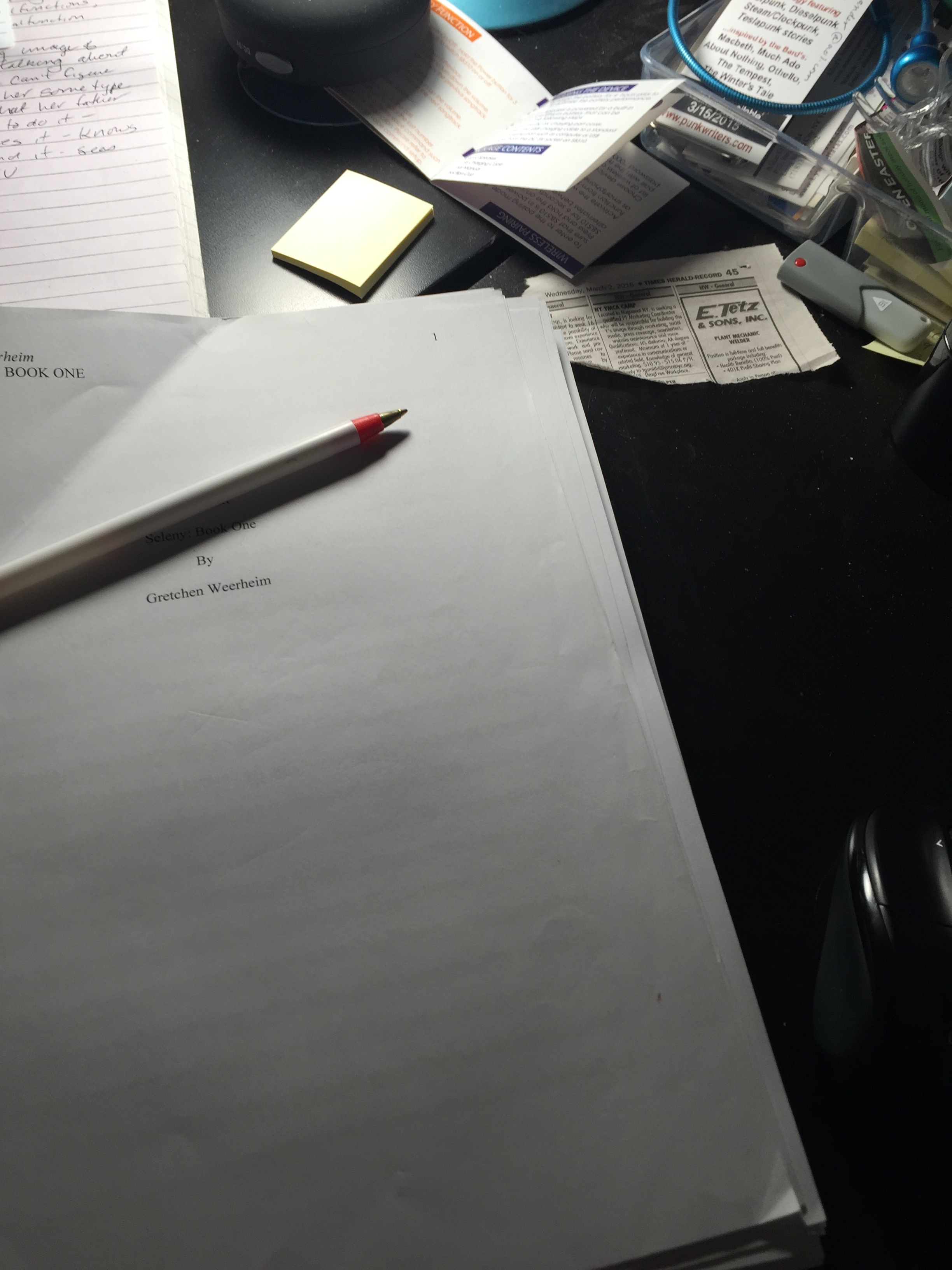
The neater part of my desk…
It started about two years ago.
Life always has its challenges and never more so than when you and your husband decide to adopt two kids from foster care. We wanted a family, wanted to give deserving kids another chance in life, and most of all out of love. These kids needed an awful lot but perhaps the biggest challenge facing us was they were 9 and 12, to be exact. And like most things, one has to be fully committed to making positive changes in these kids’ lives, and so Andrew and I did our absolute best working hard towards doing just that.
It isn’t easy, but parenthood rarely is, but we’re brave folk and did what we could. Along the way, bits and pieces of ourselves kind of went by the wayside, as most parents find true. Fortunately, we had something to help us along. Andrew has his photography (and he’s magnificent at it) and I found fiction writing.
You see, I’ve always written. I’ve composed brochures, ad copy, web content, teacher’s guides, children’s activity books, radio scripts, flyers – you name it – and I’ve got a mountain of evidence to prove it. All of it’s either informational or cold, hard facts. No fantasy, no imaginative story lines, no arc or explosive ending. Just…information.
Two years ago, my sister Gwen and I went out to lunch. My kids were at the beach and Andrew was enjoying some precious alone time. Gwen says, “You look awful. What happened to you?”
“Parenthood, that’s what. These kids – they’re work!” (I’m leaving out a MULTITUDE of details…use your imagination)
“C’mon,” says Gwen, “You’re not the only parent out there. What’s up? You used to be so creative. You were a musician. You produced shows. You lived in New York City for 20 years! You owned an apartment in Manhattan! You ordered food over the phone and stayed out until dawn. Where did that Gretchen go?”
Truth was, I hadn’t a clue.
Gwen knows what a sci-fi fanatic and astronomy freak I am. Sat on the board of an astronomy club affiliated with the Museum of Natural History in NYC, and yes, that certain famous astrophysicist was also on the board and he’s really one of the nicest, down-to-earth people I’ve ever met. Never missed an opportunity to look up to see what’s there. Received “Sky & Telescope.” All that and more. “So this is what you do,” said Gwen. “Tap into that and come up with a story. I’ll help you.”
A few months later, Andrew went off to England to visit his family, the kids were in bed and I sat in front of the computer and stared. I tentatively placed my fingers on the keyboard and let them glide over the letters. They hit letters that turned into words. Those words turned into the roughest of outlines. Andrew came home, we went out for coffee and I told him about it. After listening to my story, he joined in. Here we were, in a java joint, flushing out finer details and possible motives. Before you know it, he became hooked, too.
Andrew’s a fanboy, so his input’s invaluable, especially when it came to world building. We both weighed in on my plot devices, creations, characters, what they were up to and the messes they found themselves in. When I got to the end, he came up with such an amazing twist, I never even considered it, but once he said it, it made perfect sense. And believe me, it’s a doozy.
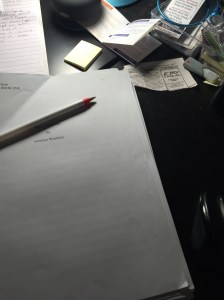
Once I hashed out these ideas in prose, Gwen helped me make nice with it. She’s the MFA in creative writing, a college professor and is published by Harper Collins (see above paperback in picture, one of her collection in print). She played devil’s advocate, told me what was stupid, or good, or on its way to being good but most of all she convinced me I really did have talent and could do this.
I joined a fine writer’s group where nearly all the members are published, and at least half are bestsellers. I participate in their writer’s conference that attracts over 300 people each spring, using it to hone my craft and make connections. I’ve kept up on trends and buried myself in my office spending hours writing, or trying to. Andrew constantly sends me links on things he believes will help and Gwen keeps checking my work. Best of all, I have a circle of writer friends who keep me keeping on, encouraging me when I think I no longer have it in me. I even got a cousin of mine involved – he’s a MAJOR fanboy and he’s reading the book to see what he thinks, and my librarian friend, who read a VERY rough draft last February, is reading it once more.
Yes, folks, I’ve gotten through four rewrites, but I’ve gotten extremely favorable feedback and possibilities for it (the printout of the manuscript is also in the picture). I have to admit I’m really proud to have shaped this story, but ever grateful that I had a cheering section helping me get through it all. Along the way, I’ve learned to let my nonfiction self go (and BOY, was that hard!) and embrace sentences in quotes that weren’t grammatically correct (clue from Gwen: read your quotes out loud. Do you talk like that? No? Then don’t write it that way!) and let my brain accept the unacceptable (tip from Andrew: why not? It’s your world, after all).
I guess my last thought is this: you can’t do it alone. So don’t. And sure, you can write. Everyone has a story to tell.
Even me.
Even you.
Now get going and write it!









 Moon, Stars and Beyond