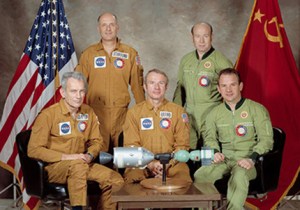
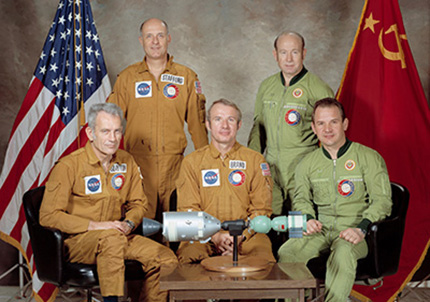
Apollo-Soyuz Crew, as shown on NASA web site, Apollo-Soyuz mission information page
Despite the fact that there always seems to be saber-rattling between the United States and Russia, our space programs get along famously.
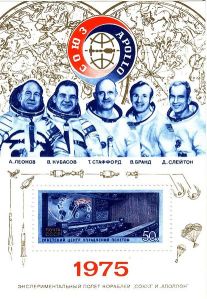
Case in point: on July 17, 1975, Soviet and American spaceships linked together for the first time during the mission known as the Apollo-Soyuz Test Project. Three American astronauts, Brig. Gen. Thomas P. Stafford, Deke Slayton and Vance D. Brand and two cosmonauts, Lt. Col. Aleksei A. Leonov and Valery N. Kubasov, changed the way our nations do business in space forever. Slayton, by the way, was one of the original Mercury Seven astronauts
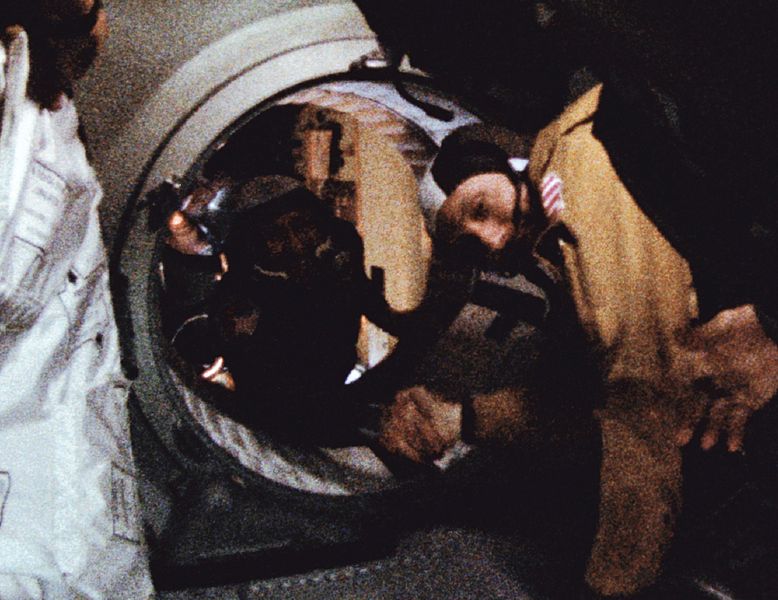
During this nine-day space mission, the American Apollo command/service module, or CSM, linked with a Soviet Soyuz spacecraft. The docking collar, which enabled the two spacecraft to connect, was developed cooperatively between NASA and the Soviet Academy of Sciences. On July 15, 1975, the Soviet Soyuz-U and Delta IB launch vehicles (that’s rockets to you and me) lifted off within seven and one-half hours of each other and docked two days later. After three hours of docking, the hatches opened. Mission Commanders Stafford and Leonov reached towards one another and engaged in the first international handshake in space.
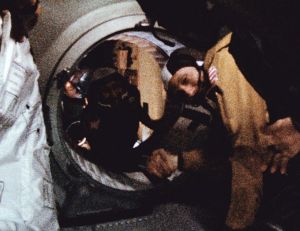
NASA, First international handshake in space: Stafford in foreground, Leonov in background
The joint crew spent 44 hours together conducting scientific experiments, exchanging gifts and flags, visited each other’s ships, ate together and shared a few laughs. Stafford tended to speak Russian with a drawl, prompting Leonov to joke that he spoke “Oklahomski.” President Gerald Ford made a phone call to congratulate the men on their mission, and a statement was read by Soviet President Leonid Brezhnev.
After the mission had ended and both crews returned to Earth, citizens of both nations delighted in shared accomplishment. President Ford personally greeted the cosmonauts. The Americans took their Soviet colleagues and friends on a tour of the United States, and the Soviets returned the gesture with a tour of their own.
In 1977, Soviet astronomer Nikolai S. Chernykh discovered a minor planet in the asteroid belt and named it 2228 Soyuz-Apollo, to commemorate this unique mission.
On February 19, 2014, Valery Kubasov died at the age of 79. No cause was given, but certainly members of the space community of all nations felt the loss of this pioneer of cooperative international missions. He served as the flight engineer and technical expert.
Today, this legacy continues on through the International Space Station and other missions, both off-world and on, through the dedicated scientists, space engineers and others, who recognize that the shared accomplishments and discoveries through cooperation far outweigh those of less peaceful purposes. Perhaps one day scientists will become presidents, and the world will be ruled by logic instead of vice.
One can only hope.
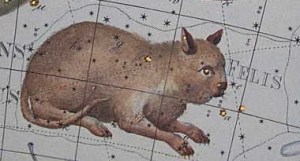
Felis, as depicted in “Uranographia,” Johann Bode, 1801
There are eighty-eight recognized constellations in the evening sky. Depending upon one’s latitude, each will make a grand entrance or hide in the wings. For example, the Southern Cross isn’t visible north of latitude 20 degrees north. Everyone below that enjoys it at least part of the year. Orion hunts nearly all latitudes every winter, but he’ll never catch the little bear in New Zealand. That one never strays that far south, and anyone south of latitude 10 degrees south never will.
Casual stargazers, no matter where on earth they live, will never experience the joys of standing in a dark field to pick out the stars of Felis. And try as one might, The Battery of Volta just won’t appear (although it sounds as if it’d make a great mystery). Sadly, at Christmas, there are no word to express how disappointed a child might be to learn that Tarandus gel Rangifer has better things to do than show up in her backyard.
Why?
Welcome to the world of obsolete constellations.
Yes, folks, if you thought the stars were permanent, well, they are, but it’s their groupings and names that pass on into the literal unknown. They fade into obscurity as we surely all will.
But who gets to name them in the first place? Excellent question. I’ll address that in another blog.
To answer this question on how it applies to constellations, here’s a quick answer: some astronomer made them up. In the case of Tarandus gel Rangifer, it was the creation of French astronomer Pierre Charles Le Monnier in 1736. He wished to commemorate an expedition from Maupertius to Lapland whose goal was to prove the Earth’s oblateness. Rangifer never caught the public’s imagination, or, it would seem, awareness.
Oh, by the way, it means “Reindeer.”
Argo Navis, or the ship Argo, falls into a grey area. It still sails the southern skies (albeit backwards) mainly in the first half of the year, but due to its unwieldy size, it was broken up into four constellations: Carina (keel), Puppis (stern), Vela (sails) and Pyxis (compass). Out of the forty-eight constellations that Ptolemy recognized, it is the only one no longer recognized from that group. You can thank another French astronomer, Nicolas Louis de Lacaille for busting up the ship, as he did in 1752.
One can, however, still piece Argo together, if one chooses. A star grouping shared between Vela and Puppis forms the asterism “False Cross,” which is a poor man’s version of the Southern Cross. So you know, an asterism is a grouping of stars that isn’t officially recognized as a constellation at all. They’re just part of someone else’s turf, like the Big Dipper is really part of Ursa Major.
Next time you stand out on your lawn and give those nightly lanterns a good look and find yourself thinking, “Hmm, who did you used to be?” It won’t be some faded Hollywood has-been…just a few misplaced, rearranged constellations, faded from the celestial scene.
It’s well known that in space, it’s quiet. No noise, no nothing. After all, it’s a vacuum, right?
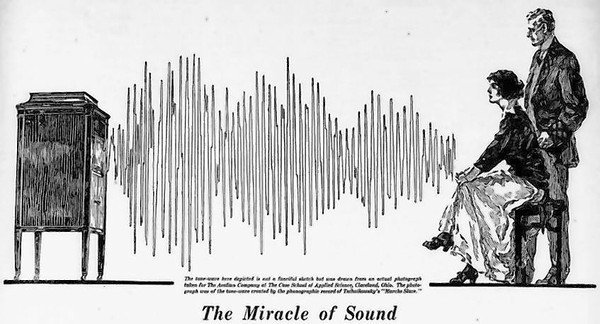
Truth be told, there is sounds that can be heard, if you know how to listen. Thanks to NASA, they’ve shared terrific examples on their website. Here’s a brief sampling of what lie out there. Let’s start out and work our way in.
But first, a bit of an explanation. Some of these sounds were originally captured as radio waves and were converted into sound. What’s the difference? A sound wave is a longitudinal wave caused by particles passing on vibration. The radio wave is a transverse wave and is electromagnetic waves. In other words, sounds result from causing something to vibrate, whereas radio waves rely on electromagnetic origins.
Returning to our sounds…
In September 2013, Voyager project scientists released to the public sound captured on its durable (or should I say, ‘endurable’?) 8-track tape player. The high-pitched sounds provided evidence that Voyager had entered a region of cold, dense, interstellar plasma. Our worlds-weary intrepid friend had finally left our solar system for good, to seek out whatever lie ahead and dutifully report back its findings. Ready to give yourself the chills? Play this link: Voyager Reports Back.
As Cassini wended its way around Jupiter in 2001, it picked up some interesting radio waves. These are the results of scientists converting the radio to sound waves.
Galileo picked up these transmissions from Jupiter’s largest moon, Ganymede (the first 20 seconds are silent).
Here’s one from Earth. It’s the whistle heard when ultra-cold liquid helium-3 changes volume relative to the North Pole and Earth’s rotation.
And right here on our home planet, directly from the forest, are translated sounds from tree rings. No, it’s not space, but it’s kind of weird.
Enjoy!

I’ve seen the film “Gravity” and it’s a tension filled, zoom-above-the-earth tale meant to demonstrate how dangerous life can be in space. I also know that a portion of what was depicted in the film is not correct, but then again, how entertaining could a 100% scientifically accurate film be?
I agree. Boreville, USA Sometime, though, there really are stories that are 100% true of bravery despite obvious risks.
Take the case of Dale Gardner.
In 1984, Commander Garder and Dr. Joseph Allen used what amount to a jetpack (that’s a nitrogen gas-powered manned maneuvering unit, or MMU) to retrieve two stranded satellites, the Palapa B-2 and Westar 6, and load them into the shuttle Discovery. Both had been deployed from a shuttle and slipped into useless orbits, due to the malfunctioning of their kick motors. Gardner connected the Palapa B-2 to the shuttle’s mechanical arm but unable to load the satellite into the cargo bay.
For 90 minutes, 224 miles above the earth, both astronauts struggled to maneuver the satellite into place. Easy enough to move it around in space, it was hard to stop and it nearly collided with the Discovery. With the help Anna Fisher, another astronaut, the Palapa B-2 was eventually loaded into the cargo bay.
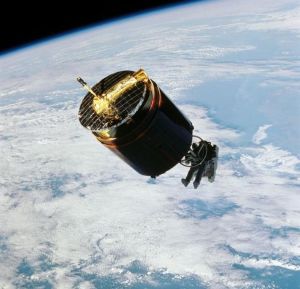
That left one more satellite to load, the Westar 6. Garder and Allen had fewer troubles moving it into the cargo bay this time, fortunately.
These three astronauts proved that one needn’t throw away $35 million dollars because a satellite won’t function. They were rescued and brought safely back to earth.
This was the last time MMUs were used in space.
It’s my sad duty to report that Dale Gardner died on February 19, 2014 at the age of 65. You can read a little more about his life in the New York Times, at this link: http://nyti.ms/1eDCqNk
What a wild ride it’s been. And now, he floats above us forever.

The constellation Ophiuchus (The Serpent Holder), as shown on http://www.frostydew.org
Most people take for granted that there’s a safe, stable number of zodiac constellations: 12. I bet you can even name them. But here’s one that you might not know: Ophiuchus.
Who?
You heard me: Ophiuchus.
My friend, I’ve been a Ophiuchus fan for years. He’s the most underrated member of the ecliptic going. His legs dangle ever so tenuously into the zodiac, just above Scorpius. He’s actually trying to step on it – wouldn’t you? Planets have been know to trod on his toes or through his legs.
So why isn’t he part of the party? There’s all sorts of reasons for that. Some say it’s traditional to have 12 signs of the zodiac, but the more practical application is that the area around the constellations has been allotted and Ophiuchus’ official territory doesn’t count for much. In fact, I could write a million blogs just about that, but why bother? What makes him most interesting is he’s also thought to be the only celestial representation of a historical person.
According to H.A. Rey, noted amateur astronomer and writer of “Curious George” books, he states:
“To speak of the Serpent Holder [Ophiuchus] as a doctor is not a mere whim. The figure is thought to represent Asklepios, Greek god of medicine who can be traced back to the Egyptian Imhotep (about 2900 BC), eminent physician and architect and first man of science in recorded history. The Serpent Holder thus becomes, indirectly, the only constellation representing a historical person.”
In Greek mythology, Asklepios was a doctor who knew the secret of death. Since his patients continued to live healthy, productive lives, Hades, the god of the underworld, grew uneasy. No deaths, no need for an underworld. Dr. Asklepios’ services were called into order when Orion was killed by a scorpion. As Dr. A tried to revive him, he found himself on the business end of a lighting bolt, shot by none other than Zeus himself. Hades had called on his brother Z to do the dirty work, in order to continue his employment. But the good Dr. A was recognized as a worthy sort and so found a home for eternity among the stars, along with Orion’s killer scorpion. They reside on opposite sides of the night sky, so when you see one, you cannot see the other. Keeps everyone out of trouble this way.
Ophiuchus isn’t just a zodiacal oddity. He has planets of his own. 15, to be exact. So why bother with waiting for any of our solar system’s planet to cross his territory when he doesn’t have to? One planet in particular, GJ 1214, is only 42 light years away and is presently being observed for more data.
If you’d like to see Ophiuchus for yourself, his calling hours are generally late May, July and August, in the southern portion of the sky, just above Scorpio. He’s a little dim, but on a clear night you can pick him out.
And who knows? One of these nights, you might find a planet wandering nearby.

Here’s a mystery for you: How can one recognize a sound if one doesn’t know what one is listening for?
Envision the sound of water dripping. To us, it’s immediately identifiable. A persistent plunk of droplets, often landing in unwanted places. That faucet with the worn valve, a pipe’s joinery weakening, even raindrops plopping a steady rhythm – all instantly recognizable, regardless of different circumstances. It’s water. We know that.
Now imagine that sound broadcast over light-years’ worth of distances. A resident of another galaxy hears it. Perhaps on his or her planet, water evaporates or freezes. Will this off-world listener misinterpret our ambient noises to be a distinct language?
As depicted in the movie, “Contact,” our broadcasts words, laughter, music, applause and other activity drifted out beyond our solar system’s outer reaches. We only know what passes for language here on Earth. How do other life forms communicate? Perhaps applause might not be recognized as having a function. Music might not exist at all. Laughing might be a language all unto itself.
We allege that our off-world companions might exhibit the same traits as we humans do. It’s only natural, since we don’t have any standard method of comparison. Our Earth is filled with a virtual cacophony of sounds, each bearing a unique interpretation, all providing information we need to assess our reaction, if any is necessary. How, then, do we describe to our off-world friend what exactly we are hearing when we cannot communicate the definition of it?
What happens when we hear our first off-world sounds from a habited planet? A friendly gesture might resemble explosions. Our experience tells us we are in danger. Our foreign friend freaks out when charged with guns and bombs, and then what? The Off-Worlder retreats or worse, dies.
Sound waves travel differently given the amount of resistance they encounter. A bell changes its tune as it rises in altitude. Temperature also affects sound. String instruments hate the cold. Drums can be cooperative, although animal skin drumheads shrink or expand with the temperature and humidity.
An off-world sound brought to Earth can lose its characteristics unique to its planet and present an entirely changed audio experience. How to identify a sound never before heard? Good question. I thought about that and wondered how I’d react. I’m curious and I’d investigate. I’d do that, though, only if the sound registers in my ear. If my cat ran off or the neighbor’s dogs started barking like crazy, and nothing was around to set them off, then what? Or if that sound destroyed object like a laser – a highly concentrated,focused beam of sound silently destroyed selected targets, I’d seriously worry.
Sounds like a mystery to me…
All right. I’ll confess. I was a diehard Stargate SG-1 fan. Not so much Stargate Atlantis, although I adored Rodney McKay. There was nothing false about him; he met at the intersection of reckless bravery and shameless coward. And Stargate Universe? Highly underrated. It wasn’t as lighthearted as the other two, but it made you think. I’m also a fan of Robert Carlyle.
I digress. Back to SG-1.
All the cast members on that show shared a real chemistry, and it could be serious and funny at the same time. The gate spun as if a Wheel of Fortune, upon which the SG-1 team gambled their fates each time with each threshold crossing. Stepping into that endless whirling stream of psychedelic colors gave Jack, Sam, Teal’c, Dan and and whoever else they dragged along, the appearance of a magic tunnel ride, forever in length. Yet, when they came out on the other side, it was as if they were out for a Sunday stroll, only two seconds later, if that. Okay, they were armed to the teeth and occasionally they’d have to dodge flying missiles, unknown assailants, and, of course, those pesky Goa’uld.
Now it’s time to go home. Either Jack’s gang saved the day or got the hell out. They’d go flying back, hurling their bodies through the stargate once more, fighting against all odds to dial the correct address to open that slurpy rush of wormhole matter. Correct me if I’m wrong, but it wasn’t entirely unheard of to have alien weaponry zing through that very wormhole. And again, traveling that eternal length of wormhole only took, what, two seconds on the return trip. Hmm.
So tell me: how’s that possible? Do wormholes stretch and contract? Now, I haven’t yet had the opportunity to leap through one of those and find out for myself, although it is on my bucket list. I am of the opinion that wormholes are a function of time meeting distance. Sort of like pulling the middle of a length of chain, and the ends become closer. Time is the chain, in this instance. Yes, I know, the chain is the same length, but suppose there was a way to skip across from one end to its opposite?
The stargate connected to other stargates in the universe, offering limitless opportunities for adventure. And convenience. Take, for example, who taught all those off-world races to speak English so beautifully? Was one of the Ancients, say, a past life of Noah Webster? Their history, beautifully preserved in the pyramids of Egypt, could have traveled through those wormholes and planted the seeds of English to the ancient Saxons. Ancients pierced the mind of Earthly citizens everywhere, giving rise to English’s seeming dominance throughout the globe. Bilingualism is an Ancient trait.
When I’m stuck at my desk, going adrift staring at the pile resting on it, I long to take a journey through a stargate. Perhaps one day on lunch break, during a mind-clearing stroll through the park, fluttering leaves in the woods might attract my attention. A bend of branches in a peculiar manner carves a path to a smoldering circle, holding open its gate to unknown possibilities, as vast as space.
I wouldn’t say no. I’d go.

Every night, when I look up at my familiar winter friends, I have to remind myself they’re long gone.
At least from my perspective, anyway.
Here’s what I see: Orion charges in a dark field with his faithful dog. Is he hunting the hare or the bull? Do his friends, the Gemini Twins, help him catch his prey? Or is he on the banks of Eridanus, awaiting an enemy?
Here’s what is: The light that shines from those stars has left so many years ago, one can only make predictions where they’re located today. Based on red shifts and calculations, it’s not too difficult to determine where the stars in the above constellations have shifted.
Here’s what makes me wonder: What was the world like when the light from Rigel (the right foot of Orion)?
In order to consider this, one has to realize that the light from Rigel left 500 years ago (it’s 500 light years away). That would mean in the year 1514, light particles separated themselves from this bluish-white supergiant, hurtled through the void of space, penetrated the Earth’s atmosphere and landed in an observer’s field of vision.
Copernicus, in 1514, had his own questions regarding the sky above him. During that year, he made his first observations of Saturn. Data gathered from this and other observations of Mars and the Sun led him to discover the earth’s orbital eccentricity, or deviation from a perfect circle. He also was of the radical opinion at the time that the Earth was not in the center of the solar system. Ptolomeic theory, officially approved by the Catholic Church and accepted as the only explanation for things planetary and universal, also decreed that orbits were perfect circles, and, as an added bonus, the Earth was indeed the center of the universe.
All this must have seemed like great science fiction to the ever wise fathers and hierarchy in Rome. Though Copernicus took minor orders in the Catholic church, his faith in God must have been piqued when he made his discoveries. Imagine that all he ever believed was suddenly called into question because of the methodical works and meticulous observations of the nighttime sky. What to do? Believe what nature tells you? Or what the Catholic Church orders you to believe?
Imagine the conversation Copernicus held with colleagues, who presumably believed he might be onto something. Now try telling that to the village priest, who might have considered him to be the village idiot or instrument of the devil. “Say, guess what?” Copernicus’ conversation might have began. “I found out we’re not in the center of the universe any more! And guess what else? Earth rotates around the sun, not the other way around! How about that? Like, OMG, that’s a BFD!”
For the average citizen in 1514, who might not have had a grasp of scientific principles, this was blasphemy, pure and simple. But the thing was, Copernicus only shared this info with a handful of people. It wasn’t until years later, as he neared death, that his work on his findings was published. Others, such as Galileo, took the heat for this and other discoveries until science finally raised his heavy hoof and triumphed.
There’s parallels here. What seemed so absolutely wild, even one hundred years ago, is feasible now. All because a person woke up one morning and said, “Now, what will I find out there among the stars?” It didn’t matter that the light shining on them was from 1514, or 240 BCE. Or visible from earth. That person knew the stars held secrets worth sharing, and he/she set out to tap into them.
So. Go out and observe Orion. Say hi to Rigel. Ponder all that happened in the time that passed during those 500 years of light travel. Tap into it. Take a piece with you. Take a chance. Make a change.
After all, our future shoots right out of our past.
The Future.
What, exactly, do those words mean to you?
Are you like Ted Forth, who daily registers his disappointment because he’s unable to commute by jetpack? Or that our world will be inhabited by aliens? That our society will take a sinister turn, only to be run by androids, or a version of them, such as in “The Matrix?” Or the world will be hot, starving and few of us will lead lives of our own choosing, such as in “Logan’s Run” or “Soylent Green?”
My take on the the future’s pretty simple: it’ll be pretty much the way it is now, only different.
We’re still going to get up in the morning, complain about the way things are and discuss the weather. Some will fall in love, choose to share lives together, bear or adopt children or not. Life will be fair, or a disaster. None of that will ever change.
What will change is the method by which we live our lives. Do we integrate technology to such a degree that we can’t separate ourselves from the stack of electronics we’ve accumulated? Or do we segregate ourselves from the gizmos that govern our being?
Who governs our future? Do we sit idly by, grousing over government and those we elected, or do citizens take personal responsibility over the choices they make each time they visit the voting booth? Or do we choose to ignore our citizen’s obligation to vote and bury our heads in the sand whenever election time comes around?
Believe it or not, the shape of our future lies in all of our hands. The future is not defined by what’s going to happen to you. Your choices govern how the future will be.
Enough soapboxing.
I’d like to devote this blog to all aspects of The Future, as interpreted by Science Fiction, political developments, earth changes, society at large and whatever else comes across my mind. Some of it will be how the future looked in the past, and how our past has shaped the future. I promise it won’t be preachy or agenda furthering, just an exploration of what lies out there – including the moon and stars, and beyond.








 Moon, Stars and Beyond