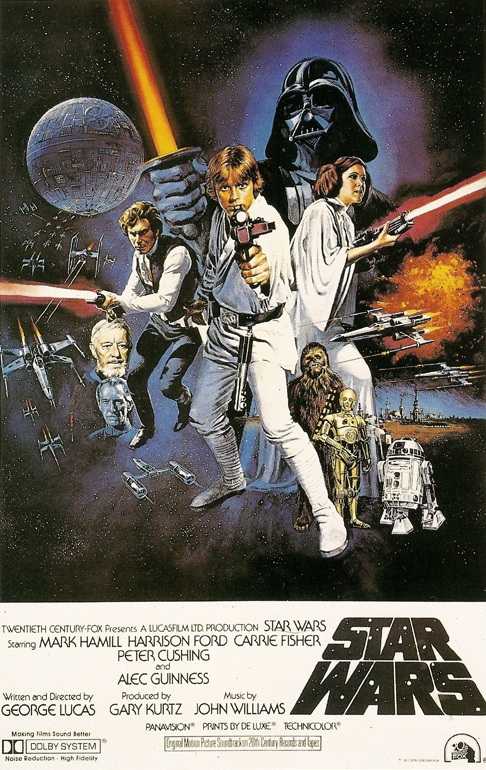
You’re sitting in your favorite chair, reclining and relaxing to that iconic sci-fi morality tale trilogy, Star Wars. You’re petting the cat, eating popcorn as you watch planets blow up, walkers trip and burn, even the Death Star going ka-blammo! It’s all good fun, and you even find yourself cheering.
But did you even consider the toll? I hesitate to say “human” toll…many species lives were lost. And it’s kind of sad, don’t you think? But then again, it’s all in the name of a heroic cause, and now, if you click on the above link, you’ll have your opportunity to cheer on the death and destruction, as Digg has tallied all 2,005,645,868 deaths in the original Star Wars trilogy.
Quite a feat, I’m sure, but worthwhile, just in case you wondered…and admit it…you have…
Saturday’s tragic crash of Virgin Galactic’s space plan over the Mojave Desert was inevitable. Two highly regarded pilots subjected a new technology to a test that partially failed. I say “partially” because the launch plane lived to see another day, while the space-skimming component didn’t.
As horrific as it must have been to watch the crash, again, I say, all knew it was a definite possibility. Anyone who flirts with the impossible does. Is it wrong to test fate? Certainly not. It’s expected. Demanded, even, if humankind’s going to stretch its limits to infinite levels.
Long before the days of Icarus, the absence of wings from the human anatomy led the drive to create the next best thing. Someone’s always thought up of a way to fly without success, but it wasn’t until November 1783 that two French citizens, Jean-François Pilâtre de Rozier and François Laurent d’Arlandes, took flight in a hot air balloon created in 1782 by Joseph-Michel and Jacques-Étienne Montgolfier. That’s when the earthbound soul could gaze upon the world in an entirely new perspective.
For the next 100+ years, serious study involving the physics of lift and sustained flight occurred. Notably, Sir George Caley’s work led to the first manned, controllable glider capable of sustained flight in 1853. Throughout the remainder of the nineteenth century, important research and experimentation regarding steam-propelled flight occurred. In 1874 Félix du Temple created an aluminum plane with a 13-meter wingspan. After launching from a ramp under steam power, it remained airborne for a short but significant hop, causing it to be the first hop achieved powered by an engine. In 1875 Thomas Moy set into flight an tandem-winged monoplane dubbed “The Aerial Steamer.” Alexander Mozhaiski, a Russian, built a steam-powered monoplane and in 1884, managed to launch it from a ramp and it remained aloft for 98 feet.
Each of these experiments edged pilots closer to their goal of sustained flight with the use of power to achieve it. Here’s where the controversy comes in. Gustave Whitehead fans know for sure it was he who took to the air on August 14, 1901 in Fairfield, Connecticut and stayed there using his Number 21 Monoplane. It was an event reported in the Bridgeport Sunday Herald. In January 1903 he claimed to repeat his feat two more times. Even Jane’s All The World’s Aircraft stated in 2013 Whitehead was first.
On the other hand, the Smithsonian Institution is sticking to its guns saying that the Wright Brothers, using their unstable, nearly unmanageable aircraft, took flight at Kill Devil Hills, North Carolina on December 17, 1903. Each brother had his turn, with Orville flying 120 feet in 12 seconds, and Wilbur beating his brother by going 852 feet in 59 seconds.
All these contributions were significant. In ten years’ time, flying machines progressed to such a level they became not instruments of how humans can soar with the birds, but shoot them down like game. World War I pilots became famous and infamous, as their canvas and wood planes were capable of killing not just the enemy, but anyone who was brave enough to fly them.
After the war, flight technology progressed rapidly. Aviators pushed the limits as quickly as the engineers who built the planes they flew. Charles Lindbergh was the first to cross the Atlantic without stopping, and Charles Kingford-Smith was the first to cross the Pacific uninterrupted. In 1924 the first aerial circumnavigation was conducted by the United States Army Air Service using a team of pilots.
Of course we all know what came next. World War II brought on unparalleled use of planes as weapons, with the first jet coming from Germany at the end of the war. That led to a combination of supersonic planes and the development of rocketry. Far more pilots died as a result of war than as a result of experimentation of new technology, but it is although through the applied usage of flight that humans have created new boundaries to serve new purposes.
Planes launched a powerless Enterprise, the first American space shuttle. Eventually, rockets got them into space. The missions also met with tragedy twice. But look what those missions gave us: a new understanding to what is possible, and what might be.
My heart goes out to the families whose members made the ultimate sacrifice for pushing the boundaries. Their contributions are not forgotten. Their deaths are not in vain, but will one day serve as an example of what can be ultimately achieved when one bravely steps out to take the ultimate risk.
For those of you who weren’t awake, aware or available, there was a full eclipse of the moon last night. Now, I’m also one of those who, for various reasons, wasn’t able to cast my eyes skyward and catch the moon at its best. Sometimes the moon just doesn’t seem to take into consideration that many of us are located on the wrong side of the globe (or clock) to be able to glimpse at the glowing red orb up in the nighttime sky.
If ever anyone wanted to be an astronomer and didn’t have the time, patience or ability to go to school for astrophysics, yet wanted to partake of the universe in an engaging and useful way, then Slooh is for you. It’s a membership organization and it isn’t cheap, but anyone will have access to high-powered telescopes in the Canary Island and Chile, plus get in on a myriad of missions. The universe is literally at your desktop.
As a participant, one also joins a community of like-minded individuals who cast their eyes skyward share what they observe. Also, one gets in on all kinds of neat stuff that NASA offers, too. In fact, Slooh engages NASA and a community of citizen astronomers to help with its near Earth asteroid project. So if you see something, you can say something!
I’ve included the below link for those how want to experience the eclipse and/or get a taste of what Slooh can do for you. Enjoy!
Here’s one of the creepiest videos I’ve seen in a long time. It’s a work in progress by Australian artist Chris Jones. It’s a fascinating study on how to reproduce a human without being human at all. Visit the link to his website and you’ll be fascinated at all of the work that’s involved in creating such a realistic life form.
To me, it’s a game changer…and might even change some of those video games we all think are so real…
Though nuclear holocausts are always in vogue with sci-fi, especially in dystopian stories, how does one choose a favorite? Sure, sure, there’s all sorts of post-bomb, pre-bomb and oh, boy, you’d better get running because here it is, DUCK…AND…COVER!
On a French class trip to, well, France back in the 1970, I sat on a bus, blithely admiring the glorious countryside outside the window (we also traveled to The Netherlands, Germany, Luxembourg and Belgium, too – in nine days). My French wasn’t great, but I knew enough to figure out that the story coming across the radio on the bus intercom said something about the nuclear reactor melting down at Three Mile Island. Hmm, I thought to myself, isn’t that less than 100 miles from my home? Oh yes, folks, it was.
Back home in science class, we students discovered how cheap and plentiful nuclear energy provides everybody with all that juice needed to keep lights on and TVs glowing. New Jersey, my state of birth, had two plants and nearby Pennsylvania had one, too – Three Mile Island. Figuring that I was probably safe in France, although maybe perhaps my parents might share a few concerns about their relative proximity to said nuclear power plant, I worried a little. A newspaper photo I still remember showed a woman cradling a baby, protectively wrapped in a towel, unaware that a stone building or basement provided far better protection. Turned out, everyone was fine. For now.
Ironically, a film that opened shortly before all this occurred, The China Syndrome had a similar plot but nowhere near as nasty as what was going down at said nuclear plant.
I must confess the best film I had seen on the subject is the 1984 British film, Threads. Shot on a ridiculously cheap budget of less than half a million (dollars and pounds), it created a totally believable, plausible “what-if” story that had me convinced the events depicted in the film were about to occur. This feature, without dancing around the subject with deep love stories and soupy personal dramas, told the story of two families and others who find themselves literally caught between a nuclear warhead exchange between the United States and Russia. It might as well as have been a documentary, given the rather factual presentation of the story. The one scene that has stuck with me to this day: as a woman looks up and sees the contrails of the bombs, we see water coming out of her pant leg, as she pisses herself in terror. That scene was a perfect example of not needing any words to describe the emotion.
The American Broadcasting Company (ABC) had its own film, pre-Threads, called The Day After. All sorts of controversy surrounded it. ABC could barely find any sponsors willing to advertise. The writers of the film faced guff because their original script was deemed too scary and were forced to slash it from a six-hour, two-night drama a 2 1/2 hour Sunday night film. It’s basically the same story in different packaging, with the Soviets and Americans at it once again, although a slightly different scenario. I’d love to see the original, six-hour version planned, because although The Day After was compelling, it couldn’t measure up to Threads.
I was in university at the time and we all gathered around my cheap B&W TV to watch it, beers and cigarettes in hand (we were students, after all). I was suitably disturbed as I got caught up in its very fine cast searching for ways to live without dying. I remember liking it, and probably still would if I have an opportunity to watch it again, but given the far worse stories and video games that have come out since, it’d barely raise an eyebrow if shown today.
My modern-day fright is these nuclear power plants continue to churn out all of the electricity necessary these days to supply us with all those objects we own that need to be plugged in. Unfortunately, like many energy sourced plucked out of the earth, there’s waste products to contend with. Once those fuel rods are spent, there’s all that plutonium 239 hanging about. Sure, it gets buried someplace, deep within the ground, but it’s still there, for pretty much ever.
And yet, we largely ignore the ultimate energy source: the sun. Maybe once it blows up, it’ll command our attention.
Need a reason to smile and cheer yourself up? Here’s a list of popular nuclear holocaust fiction, drama and such from the good folks at Wikipedia. Enjoy!
I had to share this amazing piece of graphic art by artist Anders Nilsen entitled “Me and the Universe,” appearing in the 9/25/14 edition of The New York Times. It’s an extraordinarily poignant piece, detailing how he came to be from the beginning of time, until memory of his being fades from the living, and concludes with the end of all that is known by intelligent life.
Quite detailed in all respects, with a bit of humor thrown in, it really made me ponder my place in the order of things. Hope you’ll find it as interesting as I did.
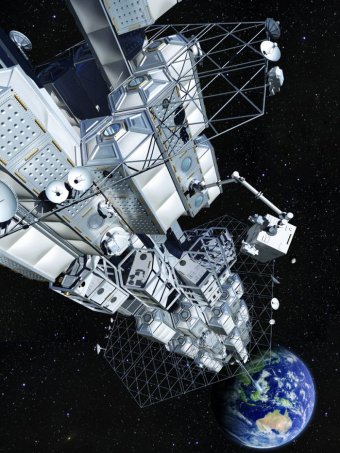
For years, there’s been all sorts of conjecture about creating an elevator to space. Why bother with rockets when space comes to you at the press of a button? It’s relatively cheap, efficient and kind of cool. NASA’s been tinkering with this idea for some time now, even offering a competition to intrepid folks willing to come up with a winning design.
In the meantime, a Japanese construction company, Obayashi, plans to have one functioning by 2050. Thanks to the use of carbon nanotechnology, it plans to begin construction somewhere around 2030. Extending 96,000 kilometers in space, it will provide an economical alternative to traditional launch-based technologies (otherwise known as rockets).
Considering what rockets cost to build and launch, it’s expected to be quite a savings in both time and resources. It is expected to transport up to 30 people to a space station and will take seven days to reach it.
From there, getting to the moon with the sky taxi should be a piece of cake. So when you next hear Frank Sinatra croon, “Fly Me to the Moon,” perhaps you’ll know what he was talking about. Who knew that man was such a predictor of the future of space?
Check this out: Boeing, who introduced many of us to the friendly skies, will be giving astronauts a lift in space. Though there are several suppliers of this rising industry, it seems as if Boeing’s got their toes in NASA.
Here’s another wonderful video from Dennis Overbye at TheNew York Times. In it, he explains how time and light partner up to offer a show from nature centuries after it occurred.
Light, in space, is literally a living memory of events long past. There’s a profound statement at the accompanying article’s end, stating that even the light on our face shine forever.
Can you imagine? That glorious day at the beach where you smiled at the sun as it reflected on the waves and your face? That’ll live on, in the shape of light rays. And so, whatever light touches, it has the ability to record and send off our particular experiences. Using light to record humanity? There’s been speculation with sound waves and how others out there will find us via our words, sounds, broadcasts. How would they make sense of our pictures? They’d arrive apart, since light travels so much faster than sound ever could.
Now imagine if both the sound and light waves intersected, but with completely different meanings. Light from the 16th century paired with sounds from this one – this jumbled mess as message. Who would read it? How might it be interpreted?
Light is absorbed when it encounters obstacles, such as black holes. Light waves, from a fairly concentrated source on Earth traveling outward, face the possibility of reaching entirely different destinations. Some of those particles risk absorption, but others fly free. A patchwork image received by an off world interpreter might wind up with a Swiss cheesy image not entirely accurate of what it was meant to represent. Perhaps, too, that’s what we might receive here at the home planet.
Darkness is the absence of light. What gives some light waves the ability to survive while others terminate, creating darkness? Or is darkness merely another form of light? Is it light that the eyes on this planet have not evolved to discern? What forms out there might interpret our version of light as darkness?
Just a little something for your minds to unravel as you attempt to rest your weary brains for the night.
Gretchen Weerheim and sister Gwen Jones with some familiar friends made entirely of Legos
Lord, it’s been hard to keep up with this blog when I’ve had so much going on in my personal life.
Summers, on the whole, are meant for enjoyment. Mine, however, consists of closing chapters and starting new ones. On the brink of Summer 2014, my mother passed away. My father, who has Alzheimer’s, deeply grieves her loss. After 60 years of marriage, that’s not hard to grasp. He refuses to leave his bed, and when he does, it’s for brief spells only. My sister and I have been taking care of him in a tag-team fashion. We’ve had to face some ugly realities, such as selling his house and placing him in smaller quarters. We refuse to place him in organized, institutional housing and evaluating alternatives comes at a cost – financially and otherwise.
All this stress really shut down my creative mind to the point where even pondering what to put down in both a novel I’m working on plus this blog made me feel guilty. I’d sit down, armed with coffee and good intentions, only to stare at the screen and wind up reading anything from The New York Times to The Comics Curmudgeon.
Last week, after a long day tending to my father and his house, I sat down at my desk and once again, grew despondent. Nothing. The sound of crickets outside reflected the activity in my brain. Seeking inspiration, I read through my older blogs, trolling for ideas, thoughts, encouragement.
I found it – from two fellow bloggers who comment regularly on what I manage to write.
Among my archives I reread “The Plot Thickens,” in which I describe an exoplanet first thought to exist and then suddenly, it vanished. D.R. Sylvester positively commented on a description I gave regarding an astrophysicist (“red-headed ball of fire”). Then Hugh Roberts of Hugh’s News and Views commented on how another brief posting of mine, “A Gorgeous View of the Universe” inspired him. Feeling somewhat more encouraged, my mind took a right turn back into my family and how they shaped me into the writer I’ve become.
An earlier blog, “Mom, Up With The Stars”, described my mother’s influence on my love for sci-fi. My father, the middle child out of eleven, born shortly before the stock market crash of 1929 and whose family fell victim to the Dust Bowl of the 1930s, had inspirations for writing. Dad had a way with words and loved good stories, especially history. Both parents encouraged my sister and I to express our artistic ways, no matter what form they took. Gwen Jones, a best-selling author whose titles appear on the Woman’s Fiction and Romance listings, encouraged me to move my writing talents from technical/educational to science fiction. Thanks to her, I belong to Liberty States Fiction Writers Group, a highly-regarded group consisting of many best-selling published writers in all genres, plus those who are well on their way. Andrew, my husband, is probably the biggest fanboy ever. His multitudes of sci-fi novels fill many of our shelves and I deeply value his input and opinions. He’s a great plotter, too.
With this basket of goodies at my table, I chose to take another approach to writing. With one novel finished and another underway, I’d thought I’d create a side project, if you will. You might notice it listed at the top of my blog – a new page called “Incurable Mistakes – A Serial Story.” Using D.R. Sylvester’s suggestion that the red-headed ball of fire astrophysicist plot line might actually work, I bore that in mind as I sat in my father’s home and began telling a tale. I invite anyone out there to come and join me. Read along and if you have a great suggestion, send it on and I’ll work it in. Call it a group novel. The only thing I haven’t figured out (haven’t tried, actually) is how to make subpages for new chapters, although I’m sure it’s easy.
I’m not making promises, but I will try to slap together 500-1000 words a week. Anything readers of this blog can add to the pot might make this stew tastier!







 Moon, Stars and Beyond