For those of you who weren’t awake, aware or available, there was a full eclipse of the moon last night. Now, I’m also one of those who, for various reasons, wasn’t able to cast my eyes skyward and catch the moon at its best. Sometimes the moon just doesn’t seem to take into consideration that many of us are located on the wrong side of the globe (or clock) to be able to glimpse at the glowing red orb up in the nighttime sky.
If ever anyone wanted to be an astronomer and didn’t have the time, patience or ability to go to school for astrophysics, yet wanted to partake of the universe in an engaging and useful way, then Slooh is for you. It’s a membership organization and it isn’t cheap, but anyone will have access to high-powered telescopes in the Canary Island and Chile, plus get in on a myriad of missions. The universe is literally at your desktop.
As a participant, one also joins a community of like-minded individuals who cast their eyes skyward share what they observe. Also, one gets in on all kinds of neat stuff that NASA offers, too. In fact, Slooh engages NASA and a community of citizen astronomers to help with its near Earth asteroid project. So if you see something, you can say something!
I’ve included the below link for those how want to experience the eclipse and/or get a taste of what Slooh can do for you. Enjoy!
Here’s one of the creepiest videos I’ve seen in a long time. It’s a work in progress by Australian artist Chris Jones. It’s a fascinating study on how to reproduce a human without being human at all. Visit the link to his website and you’ll be fascinated at all of the work that’s involved in creating such a realistic life form.
To me, it’s a game changer…and might even change some of those video games we all think are so real…
Though nuclear holocausts are always in vogue with sci-fi, especially in dystopian stories, how does one choose a favorite? Sure, sure, there’s all sorts of post-bomb, pre-bomb and oh, boy, you’d better get running because here it is, DUCK…AND…COVER!
On a French class trip to, well, France back in the 1970, I sat on a bus, blithely admiring the glorious countryside outside the window (we also traveled to The Netherlands, Germany, Luxembourg and Belgium, too – in nine days). My French wasn’t great, but I knew enough to figure out that the story coming across the radio on the bus intercom said something about the nuclear reactor melting down at Three Mile Island. Hmm, I thought to myself, isn’t that less than 100 miles from my home? Oh yes, folks, it was.
Back home in science class, we students discovered how cheap and plentiful nuclear energy provides everybody with all that juice needed to keep lights on and TVs glowing. New Jersey, my state of birth, had two plants and nearby Pennsylvania had one, too – Three Mile Island. Figuring that I was probably safe in France, although maybe perhaps my parents might share a few concerns about their relative proximity to said nuclear power plant, I worried a little. A newspaper photo I still remember showed a woman cradling a baby, protectively wrapped in a towel, unaware that a stone building or basement provided far better protection. Turned out, everyone was fine. For now.
Ironically, a film that opened shortly before all this occurred, The China Syndrome had a similar plot but nowhere near as nasty as what was going down at said nuclear plant.
I must confess the best film I had seen on the subject is the 1984 British film, Threads. Shot on a ridiculously cheap budget of less than half a million (dollars and pounds), it created a totally believable, plausible “what-if” story that had me convinced the events depicted in the film were about to occur. This feature, without dancing around the subject with deep love stories and soupy personal dramas, told the story of two families and others who find themselves literally caught between a nuclear warhead exchange between the United States and Russia. It might as well as have been a documentary, given the rather factual presentation of the story. The one scene that has stuck with me to this day: as a woman looks up and sees the contrails of the bombs, we see water coming out of her pant leg, as she pisses herself in terror. That scene was a perfect example of not needing any words to describe the emotion.
The American Broadcasting Company (ABC) had its own film, pre-Threads, called The Day After. All sorts of controversy surrounded it. ABC could barely find any sponsors willing to advertise. The writers of the film faced guff because their original script was deemed too scary and were forced to slash it from a six-hour, two-night drama a 2 1/2 hour Sunday night film. It’s basically the same story in different packaging, with the Soviets and Americans at it once again, although a slightly different scenario. I’d love to see the original, six-hour version planned, because although The Day After was compelling, it couldn’t measure up to Threads.
I was in university at the time and we all gathered around my cheap B&W TV to watch it, beers and cigarettes in hand (we were students, after all). I was suitably disturbed as I got caught up in its very fine cast searching for ways to live without dying. I remember liking it, and probably still would if I have an opportunity to watch it again, but given the far worse stories and video games that have come out since, it’d barely raise an eyebrow if shown today.
My modern-day fright is these nuclear power plants continue to churn out all of the electricity necessary these days to supply us with all those objects we own that need to be plugged in. Unfortunately, like many energy sourced plucked out of the earth, there’s waste products to contend with. Once those fuel rods are spent, there’s all that plutonium 239 hanging about. Sure, it gets buried someplace, deep within the ground, but it’s still there, for pretty much ever.
And yet, we largely ignore the ultimate energy source: the sun. Maybe once it blows up, it’ll command our attention.
Need a reason to smile and cheer yourself up? Here’s a list of popular nuclear holocaust fiction, drama and such from the good folks at Wikipedia. Enjoy!
I had to share this amazing piece of graphic art by artist Anders Nilsen entitled “Me and the Universe,” appearing in the 9/25/14 edition of The New York Times. It’s an extraordinarily poignant piece, detailing how he came to be from the beginning of time, until memory of his being fades from the living, and concludes with the end of all that is known by intelligent life.
Quite detailed in all respects, with a bit of humor thrown in, it really made me ponder my place in the order of things. Hope you’ll find it as interesting as I did.
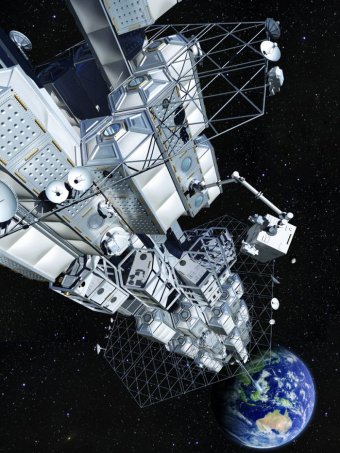
For years, there’s been all sorts of conjecture about creating an elevator to space. Why bother with rockets when space comes to you at the press of a button? It’s relatively cheap, efficient and kind of cool. NASA’s been tinkering with this idea for some time now, even offering a competition to intrepid folks willing to come up with a winning design.
In the meantime, a Japanese construction company, Obayashi, plans to have one functioning by 2050. Thanks to the use of carbon nanotechnology, it plans to begin construction somewhere around 2030. Extending 96,000 kilometers in space, it will provide an economical alternative to traditional launch-based technologies (otherwise known as rockets).
Considering what rockets cost to build and launch, it’s expected to be quite a savings in both time and resources. It is expected to transport up to 30 people to a space station and will take seven days to reach it.
From there, getting to the moon with the sky taxi should be a piece of cake. So when you next hear Frank Sinatra croon, “Fly Me to the Moon,” perhaps you’ll know what he was talking about. Who knew that man was such a predictor of the future of space?
Here’s a complete chart of all the spaceships out there. Sci-fi ships, that is.
This chart comes courtesy of artist Dirk Loechel and one look at it will tell you it’s a true work of genius and labor of love. Apparently it’s missing a Tardis, but he explains why at his site.
Credit: Gretchen Weerheim’s fabulous iPhone, now obsolete as of last week
Just had to show off this spectacular picture of high altitude clouds that I caught on the way to work the other day. I live in an area where there are lots of mountains (not very big ones, but respectable in height) and I have to drive over a ridge. I noticed these clouds as I passed near to that ridge and when I got to the top, I pulled the car over and snapped a few.
If you enlarge it, you will see details of the waves of clouds spinning off little wisps. There was a great deal of turbulence in the upper atmosphere, causing the wave pattern. These are cirrostratus clouds and a weather front was approaching, but the high winds coupled with updraft over mountains added to the instability. It’s almost as if some kind of radical charge was buzzing the cloud bank, making them spike up as they swirled.
Check this out: Boeing, who introduced many of us to the friendly skies, will be giving astronauts a lift in space. Though there are several suppliers of this rising industry, it seems as if Boeing’s got their toes in NASA.
I know, I know, one more thing about the universe and you’re going to scream, right? However, this one is absolutely gorgeous! I’ve only watched it about 100 times…
See, I guess what intrigues me the most is that space, for all its vastness, has a certain order. According to the scientists at the University of Hawaii, galaxies are but bit players in the universe. They live in gorgeous threads of light, continuing throughout time, without regard to limits of distance.
Our home base, The Milky Way, is barely a studio apartment in a vast expanse of housing, just like any small flat in a giant city – one singular home amongst millions. Yet those apartments are structured within a building, positioned on city blocks, within the confines of an area. Some areas are more concentrated than others, while other sections of the city are more spread out.
The Milky Way is similar, in that respect, as it’s placed on a long street headed towards a more densely packed region. All galaxies are subject to gravity, and are forced towards or away from a center. As habitants of earth, we are subject to constant motion: our planet rotates as it travels around the sun, as part of a solar system that lives in its galaxy that travels toward other galaxies in a cluster that is part of a larger network, all moving towards or away from a center.
To consider the endless possibilities of our universe is to feel very small indeed!
I’d say it was the early 1990s. Happened so long ago I can’t quite remember the exact year.
On this particular Friday, there was a a bit of civil unrest and a march downtown, towards the World Trade Centers; the cause, an injustice and the ensuing protest either worried people or, as was often the case in New York, completely ignored. I chose the latter as I headed to my favorite midtown Irish pub to meet my friend Louise for an after-work drink. We often met there on Fridays and became friendly with some of those who shared in our weekly ritual. You could tell it was a good Irish pub; over half were natives of the Old Country.
“Say, what’dya think of that?” said one young Irishman, pointing at the TV.
“The protest? Typical day in the city. It’ll be forgotten by the time we leave here,” I said.
He laughed. “Yea, and I heard in the subway here that the Trade Center had burned to the ground.”
Rolling my eyes, “Like that’s ever going to happen.”
* * *
It’s a few years later. Another Friday. I’m rushing to Grand Central Station with my skis slung over one shoulder, my backpack on the other. There’s more chaos than usual and even though I had my train ticket in hand, I struggled to get out of subway and into the station. I ignored all the brouhaha and raced for the train that was due to leave in less than a minute. Unsteadily wobbling towards the train that would eventually take me to my cousin’s place in upstate New York, a sympathetic conductor holds the doors for me as I leap aboard. The doors close instantly and the train lurches forward.
Every seat’s taken, but where am I going to go with my load? I lean against the sides near the doors and lose myself in my thoughts, until I can’t help but notice nearly everyone is talking about The Explosion.
“What explosion?” I ask a commuter.
“You mean, you haven’t heard?”
“No, I’ve been stuck in meetings all day. What happened?”
“A van drove into the parking garage at the World Trade Center and exploded. Not sure, maybe six, seven, ten? I don’t know, but people got killed. Don’t know everything yet, but the word is it’s an act of terrorists.”
I scrunch up my face in disbelief. “Here? That sort of thing only happens in other countries.”
The commuter shrugs and says, “Don’t know everything yet. Could be some kids unhappy about something. Story’s still developing. Whoever it was, they were wackadoo.”
By the time I arrive at my destination, my cousin knows more. “Yes, that’s right. People died. Lots of damage. The parking garage is totally wrecked. People were eating their lunch in a break room when they died.”
“God, how horrible. Does someone really think they can blow up the towers? Don’t they know they were built to withstand a 727 crashing into them?”
* * *
What a gorgeous day, I thought to myself as I boarded the No. 1 train going uptown. It was a Tuesday, and I held auditions the day before. I produced shows for kids and I looked forward to calling those who made the cut, and writing letters to those who might be on second string. I worked at Lincoln Center at the time, on the 6th floor. The door opens and the receptionist says, “Did you hear?”
“Hear what?”
“A plane crashed into the World Trade Center.”
“What, is the pilot blind?” Shaking my head, I continue to my office.
Turning on the computer, I read the parade of emails that churned through and sipped my coffee.
Suddenly, a woman screams. “The second tower! It’s hit!”
She has an itty-bitty TV that’s mainly used to watch videotapes. Turning it on to learn more about what the receptionist has said, the image of a second plane crashes into the other tower flashes on its screen. Everyone runs towards her office to see. Pretty soon, it’s evident this is no ordinary day in New York City. It’s probably the worst one in my life. Ever.
My sister calls. “Oh, thank God you’re there! I’m standing in a towel and I’ve been trying to reach you for over a half hour. There’s hardly any phone service.”
“What’s going on?” I ask.
She tells me. An iron taste fills my mouth as I can’t quite grasp the news that my beloved New York is on fire, the Pentagon is too, plus somewhere out in Pennsylvania a plane seems to have been shot down. And perhaps more’s about to happen, but no one knows…yet…for sure. “Don’t freak out,” she says, “You must remain calm to be safe. Do you hear me?”
“Sure,” I say, but wonder what safe translates into on this occasion.
Our executive director calmly informs everyone that since Lincoln Center is a tourist site, it’s being considered a target and we are to evacuate. Gathering up my stuff, I turn off the computer and leave. I’m too frightened to be scared, too much in shock to worry about what comes next.
Yet, there are shreds of encouragement tucked in corners. The cataclysmic events that brought down two towers united a city of eight million. As I walked home from Lincoln Center to my apartment in Murray Hill, the roads were clogged with traffic going nowhere. Sidewalks were lined with crowds, each gathering in front of anything that broadcasted. Monitors and displays in store windows, formerly showing videos of the latest whatevers, now presented a variety of news stations. A cop, hands waving in exasperation, shouted to a lady, “Ma’am, I can’t tell you what’s going on because I don’t know what’s going on.” Crossing through Central Park, an overturned garbage can held a boom box, ringed with listeners. A Parks Department pickup truck played its radio for anyone that cared to hear.
I crossed Sixth Avenue. My eyes were drawn to a particular, peculiar image in the distance: a distinct, crooked, Y-shaped double plume of smoke. I deny its existence and move on. Drifting down the streets, aware that I was headed home but unable to process the unfathomable series of events, I look up at the crystal-clear blue sky. How can it be that such a gorgeous day brought such a horror?
This must have been what Pearl Harbor was like, I remember thinking.
Yet for all of this, no one, and I mean no one panicked. They helped. Store owners handed out water and sneakers to tired passers-by. The police, aided by academy cadets, stood on every corner and did their best to help people on their way, soothe them, or, in a few instances, embrace those who worried aloud that their son, daughter, husband, wife, friend or other family were trapped and died. “Just get yourself home,” I heard one cop say, “and keep the faith. That’s what I’m doing.”
I finally arrive and turn the key in the door. My neighbor hears me and rushes out to give me a hug. “Come over,” she says.
“In a minute,” I reply.
My answering machine is full. Friends from England, Australia, Germany and throughout America have tried to reach me. All are crying. All fear the worst. I try to send an email but there’s no more service. My neighbor’s door is open and I walk in. She’s glued to the TV. We both have friends who worked there, and I have a close friend who worked across the street. Suddenly, a huge cloud of smoke heads uptown and we rush to close the windows. At the same time, F-16s fly over. “Oh, God, what next?” my neighbor says.
“Don’t worry,” I answer. “We’re safe.” But for how long?
Later, I return to my apartment. I’ve eaten nothing and don’t care to. Can’t watch the news any more; the sirens blaring and planes above tell me what I tune out. Closing my eyes as I fruitlessly try to sleep, the repeating image of crashing towers plays a loop in my brain. The next day is equally beautiful, but eerily silent. Going for a walk at 6:00 am, when the city’s just starting to bustle in earnest, it’s noiseless and still. No one goes to work. Nothing is open.
Days after, the odor of burning electricity drifts throughout the city. I can still smell it. A few blocks from my home is Bellvue Hospital, set up as a triage but turned into a morgue and memorial.
Gradually, life returned. Through all the tragedy and sorrow, New Yorkers, ever a resilient bunch, picked up their daily habits and continued on, showing the terrorists that NOBODY’S going to mess with THEIR city! We shopped, dined and enjoyed each day for our friends and family that could no longer.
Exactly three weeks after this horrific event, a British man, a friend of a friend, came on holiday, having booked months in advance.
Nine months later, we married.
Twelve years later, we still are, very much in love and quite happy.
Thirteen years later, we’ll never forget that each day brings with it fresh opportunities for love, forgiveness and hope that one day, we’ll all figure out a way to get along in peace.
Remember that, and the lives of the victims of that tragic day will not have been lost in vain.




 Moon, Stars and Beyond