Archive for the ‘Aliens’ Category

Farewell, Friend…
I heard he had gone into the hospital, but who’d ever think that Spock would die? That’s as unfathomable as space and time itself!
Spock…dead?
People of a certain age, such as myself, count their youthful years against the number of Star Trek episodes they identify with. I was quite young when they originally aired, but I remember seeing them. Later, in the 1970s, Mom always turned the show on after dinner. And there he was, Spock, spouting his quiet but firm logic against the perpetually angered and impulsive Kirk. He had a better grip on things, from his unique perspective. Half human, half Vulcan, he read into Earthly beings with insight, yet allowed his mature, tamer side to pump out the decisions that allowed the Enterprise to stay afloat in space.
So why wasn’t he the captain, you ask?
No swagger value, I’m afraid. A quiet, contemplative fellow, Spock chose to pursue feats of the brain instead of the brawn. And that’s fine, really. There’s too many jocks out there, and every braniac, nerd, geek and other reject embraced Spock with a passion, because it gave them a great model to follow. No, you don’t have to be a football player or a cheerleader – the universe needs thinkers, too!
In middle and high school, the same geeky types that were into Star Trek were also into such shows as Dr. Who and Space: 1999. Even Monte Python’s Flying Circus. We were the group that got all the strangeness because we didn’t have to worry about what people thought of us – they already thought we were weird. Our imaginations set us free, launching us into the stratosphere with odd concepts convincingly plausible. I got a bit stuck on wondering just exactly where in the universe the Enterprise was located, or headed. How come they never ran out of gas? Or water? Or food? Where did they get their uniforms from? Who did the laundry? How did they maintain personal hygiene? I figured a ship that size had to have an awfully large cargo bay. Maybe they did purloin provisions from populated planets.
My college friend Linda probably had some insight into these issues. She devoted her life (at that point, anyway) to two things: music and Star Trek. She memorized each episode, completely down to the credits. She possessed an actual female uniform and wore it when the occasion demanded it. Without hesitation she could name any tiny bit of trivia one threw at her, often showing down many a Star Trek scholar – which she proudly was – often at the price of a beer.
Still, this iconic sci-fi show would be nothing without its iconic star. Spock beckoned us to live long and prosper, which he surely did. He leaves us to enjoy the episodes which made him famous and live long in our hearts forever.

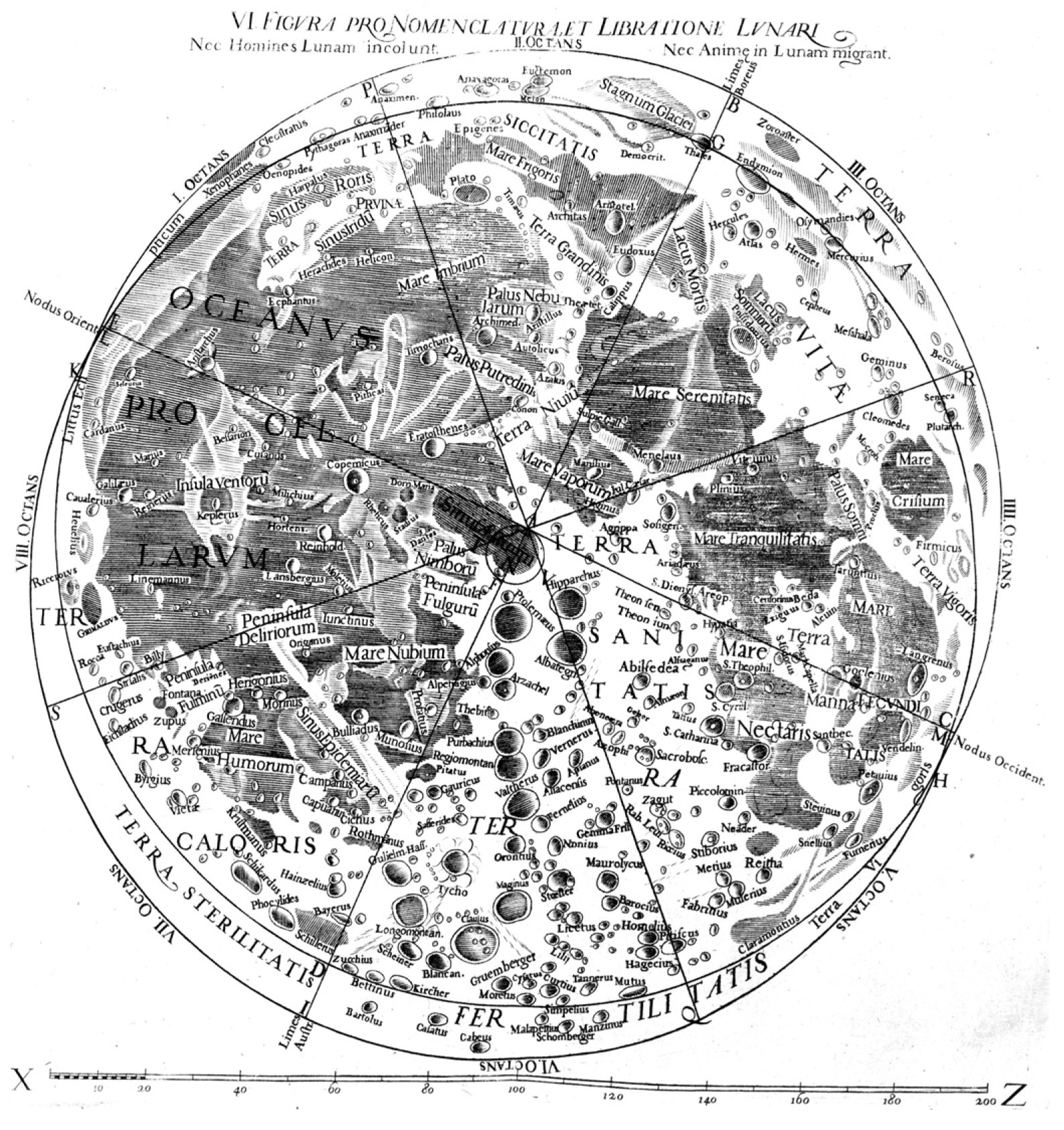
“Riccioli1651MoonMap” by G. B. Riccioli – Almagestum Novum
It used to be a common joke, once upon a time: selling a naive sucker the Brooklyn Bridge. Same goes with swamp acreage. But the moon?
Con artists throughout time dreamt up plots to sell lunar land as expansive as the graveyard along the Garden State Parkway. Don’t worry about how you’re going to get there – you’ll figure it out! Where else can you get so much prime real estate? Tell you what, it’s yours for the price of $100!
Well, there’s organizations selling star’s names to people willing to shell out money for no real reason except vanity – the National Star Registry, for example – but how real is that? Turns out, there’s interest in developing what the moon’s got to offer, and it could possibly be open to anyone with a way up and back.
Before that happens, though, there’s a few important details to consider, starting with the Outer Space Treaty of 1967 (also known as the Treaty on Principles Governing the Activities of States in the Exploration and Use of Outer Space, including the Moon and Other Celestial Bodies). Simply put, it says the moon belongs to no one in particular but to all humankind, no nation can put weapons of mass destruction upon it, and any nation that places a space object that lands upon it is responsible for any damages caused by said object.
This treaty was created well before the concept of private concerns launching their own scientific/lunar endeavors into space. But we’re entering a new stage of space conceptualization now. Private industry is poised to take over where nations once ruled. Corporations such as SpaceX already contribute to NASA missions. So what’s next? The Moon Treaty of 1979 clearly states that no private entity can profit from the moon, and whatever is reaped from the moon must be for the benefit of all. The United States, Russia and China, as well as many other nations, never signed it. While there’s no underhanded endeavor to plunder the moon’s riches currently underhand, anyone’s a fool to think that isn’t going to happen as soon as it’s possible.
And really, what’s to stop individuals from going on up and taking what essentially is ungoverned land? Think about it. Throughout the history of the Earth, nations have taken over other nations, usurped the powers of other leaders, raped the resources and ruined cultures, all for the sake of greed and profit. The entire side of the globe where I live (the United States) can thank its present existence to explorers from the other side of it, all in the name of seeing what’s there and what can be done with it. Never mind that the land was already populated and doing well enough.
Truly, it’s only a matter of time before honest lunar endeavors turn into questionable ones. In my mind, it’ll begin as an entirely cooperative gesture with clearly drawn lines. But in the end, a small incident will lead to greater dissatisfaction, and it’ll only be a matter of time before hell will break loose.
In the meantime, enjoy the view. It might change dramatically during our lifetimes, or those of our descendants.
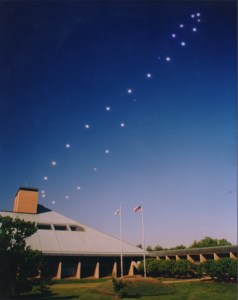
Afternoon analemma photo taken in 1998-1999 by Jack Fishburn in Murray Hill, NJ. Bell Laboratories building in foreground
Have you ever noticed in the mornings, from about mid-December to around mid-January that the sun rises the same time every day? Even though the time of the setting sun changes, the dawn keeps breaking at 7:21 am (or whatever time your sun happens to rise, depending upon where in the world you live). It’s as if it’s stuck, needing an extra nudge to get it moving. Once again, from about mid-June to mid-July, the same thing happens with the sun once more.
As illustrated in the photo above, this phenomena is called an analemma. The Merriam-Webster dictionary defines it as, “a plot or graph of the position of the sun in the sky at a certain time of day (as noon) at one locale measured throughout the year that has the shape of a figure 8; also : a scale (as on a globe or sundial) based on such a plot that shows the sun’s position for each day of the year or that allows local mean time to be determined.”
So, if one were to take a picture of the sun at the same time every day, from exactly the same position, you’d more or less wind up with a figure 8. It’s proof that the Earth’s axis is tilted at 23.439°. However, the angle at which it’s seen changes wherever one is located on Earth. The above was taken at roughly 40° north. Here is a picture taken at Veszprem, Hungary, which is latitude 47°:

Image Credit & Copyright: Tamas Ladanyi – Analemma 2011 – taken at 9:00 am
So at 47°, the sun’s angle’s a bit sharper.
Here’s an excellent link from the Washington Post that illustrates how the sun moves in the sky through the months.
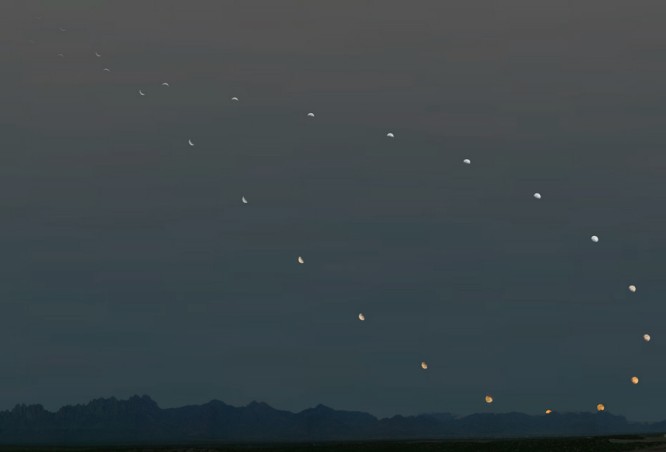
And who can forget the moon? Since it rises and sets, it too creates its own analemma. However, the moon rises 51 minutes later every day, so in order to successfully photograph it, one has to take that into account. Understanding that means the moon returns to the same position 51 minutes later, in accordance to its rising. Still, with patience, one can create an excellent example of what the moon can do, although one has to also remember it has phases. That creates a wonderful variety of shapes. Here’s an example:
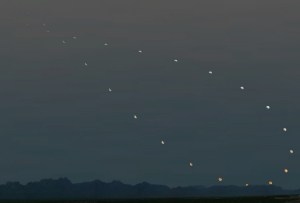
Credit & Copyright: Rich Richins
Earth isn’t the only place where the analemma occurs. Any planet where the sun shines also shares this perspective, although it’s teardrop shaped on Mars:

Digital Illustration Credit & Copyright: Dennis Mammana (Skyscapes)
Why the different shape? Here’s the explanation from NASA:
“On planet Earth, an analemma is the figure-8 loop you get when you mark the position of the Sun at the same time each day throughout the year. But similarly marking the position of the Sun in the Martian sky would produce the simpler, stretched pear shape in this digital illustration, based on the Mars Pathfinder project’s famous Presidential Panorama view from the surface. The simulation shows the late afternoon Sun that would have been seen from the Sagan Memorial Station once every 30 Martian days (sols) beginning on Pathfinder’s Sol 24 (July 29, 1997). Slightly less bright, the simulated Sun is only about two thirds the size as seen from Earth, while the Martian dust, responsible for the reddish sky of Mars, also scatters some blue light around the solar disk.”
Each planet, given its north-south axis tilt and shape of its orbit, has its own analemma shape:
- Mercury – nearly straight line
- Venus – ellipse
- Mars – teardrop (as illustrated above)
- Jupiter – ellipse
- Saturn – figure 8, but with tight northern loop
- Uranus – figure 8
- Neptune – figure 8
Let me add that you don’t necessarily need a camera to record the sun’s analemma. Think back to the movie “Cast Away” wherein Tom Hanks marks on stone where the sun travels throughout the year. You can make note by just looking out the window and the same time each day, seeing where the sun happens to be at the same time each day. It’s pretty cool. Try it!
I’m not going to lie. This has been an awful year for me. Annus horribilus. I’m not sorry to see 2014 go; in fact, I’ll be personally booting it out the door come 11:59:59 on 12/31/14. I can’t wait.
That doesn’t mean I’m going to go all Bah Humbug during the holidays, however. In fact, as a result of this terrible year, I’m determined to finish it on a positive note, or even a humorous one.
Sometimes when the self-spirit’s lacking, one has to dig deep to find the certain stuff to pull it up and out. Get that old smile back on the face. Muster up some cheer. To that end, I started with lights. Dug out the old LED outdoor string and got to work putting them on the gutters for all to see. Have a few strands of solar lights and stuck them on the bushes on the front lawn, since there’s no outlets there. Already, the house looked much better.
We did notice a couple of our older strings weren’t working, so Andrew and I went over to Lowe’s and bought replacements. Hanging in the aisle was this:

It’s a Chewbacca stocking. Andrew walks over to it and says, “I don’t care how much it costs” and throws it into our basket, along with our new color icicle lights.
The next day, I’m in Target, wandering the aisles for a few last-minute gifts and holiday supplies. I’m looking for Archer Farms Caramel Chocolate Popcorn mix when I happen upon this:

I say to myself, “I don’t care how much it costs” and toss it into the basket. It’s truly horrible, but I don’t care.
We’re the sort of family that gets its tree a few days before Christmas, so that the holiday actually has some kind of special anticipation (as opposed to those who put theirs up right after Thanksgiving, a month before). I went to the local farmers market. They always have great trees at good prices. Of course, they also have all sorts of other things that go along with holiday decorating too, so I saw this:

Oh boy. This was hard. Oh, these would look soooooooooo fantastic on the lawn, now, wouldn’t they? A storm trooper with a candy cane? R2D2 with a Santa cap? I already had a holiday Yoda, but he looked kinda cute, almost determined to celebrate Christmas with great force. One look at the price, though, and I wasn’t about to shell out $59.95 when the tree cost half that. Sensibly, I moved on.
So the other day, my son wanted to go Christmas shopping. Again, we’re back at Target and he spots these:

Oh, heck, they were only $10.00. On clearance. Such a bargain! What better way to drink egg nog? Of course, the bottom of the glass had the expected caveat:

NOT A TOY. Well, it’s not like we go tossing these things around. Who’d even think a glass is?
So here we are, putting nice things on tree. It’s all sparkle and light.

Yoda fits in so well with all the other sparkly bits and such. He’s so serene, stuck in the branches:

It’s as if he’s the keeper of the holiday spirit, beckoning joy and light, and be of good cheer.
So I will.
So should you.
Merry Christmas, Happy Hanukkah, Festive Festivus, Sassy Saturnalia, Kickin’ Kwanza, Happy New Year and all of that, to all of you.

Credit: PAZ
This picture showed up on my Facebook page. It’s a riot. I’d love to have that under my tree! Or maybe even Christmas card?
So I got to thinking: what else is there out there? I mean, to properly inspire me for the holidays? Here’s a few for you to pass around and enjoy. I got them all of the web in many different locations, so I can’t rightly say where, exactly, these belong, except in your consciousness during this lovely holiday season.

Santa passes by his alien counterpart

Robot Elf

Even little aliens deserve a little treat from Santa, who seems a little off…
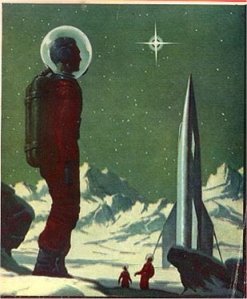
The Christmas Star, reimagined
Happy Holidays!
http://t.co/EKG1mEpIgC
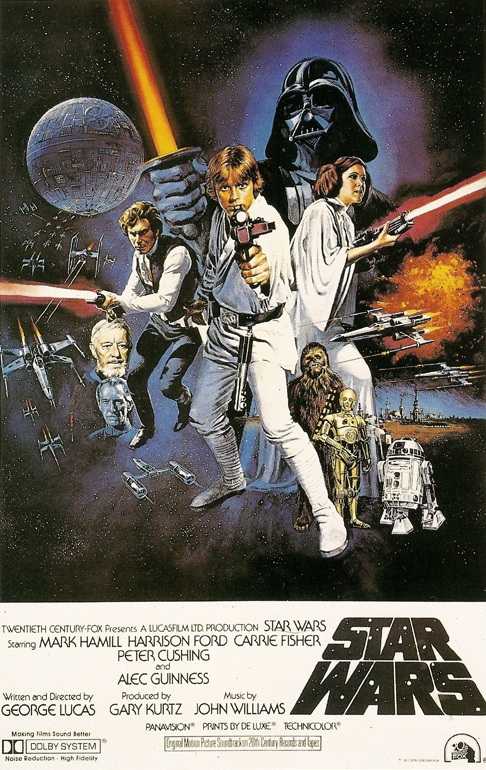
You’re sitting in your favorite chair, reclining and relaxing to that iconic sci-fi morality tale trilogy, Star Wars. You’re petting the cat, eating popcorn as you watch planets blow up, walkers trip and burn, even the Death Star going ka-blammo! It’s all good fun, and you even find yourself cheering.
But did you even consider the toll? I hesitate to say “human” toll…many species lives were lost. And it’s kind of sad, don’t you think? But then again, it’s all in the name of a heroic cause, and now, if you click on the above link, you’ll have your opportunity to cheer on the death and destruction, as Digg has tallied all 2,005,645,868 deaths in the original Star Wars trilogy.
Quite a feat, I’m sure, but worthwhile, just in case you wondered…and admit it…you have…
Enjoy!

Star Trek Continues! Check it out!
I’ve known about this for a long time, and should have written about it long ago, but as most things go, I forget, run out of time or life gets in the way, as it often does. But my husband Andrew reminded me of this and sent me a link, and that’s what got me poking around this topic once more.
“Star Trek” and I go back a long way. My brother and mom used to watch it when I was a mere speck of a kid, and then by the time I got to college I pretty much knew all the episodes by heart. My friend Linda did me one better. She memorized all of the credits. That in itself’s pretty impressive, considering that’s an awful lot of information to plaster within one’s head.
Anyway, back to the topic.
“Star Trek Continues” is a perfect example of allowing passion to guide you to success. I don’t know what’s more fascinating: the fact that the original Star Trek is continuing or the cast and crew that pulls out all of the stops to pull it off. It’s a fan-created web series with serious street cred. Make no mistake: it’s about a professional as anything that comes out of Hollywood. Each episode is faithful to the spirit of the original 1960s series in every way: storytelling, sets, costumes, music and more. After watching an episode, you’ll be convinced that the old set found new life. And in a way, it did.
How about the cast?
Let’s start with Vic Mignogna – that’s James T. Kirk, to you and me. Yes, he’s not only the star, but the director, writer and one of the producers. He’s a also a voice actor and musician, too.
The rest of the gang’s all there, too. Tod Haberkorn is Spock, Larry Nemecek/Chuck Huber is Dr. “Bones” McCoy, Chris Doohan is Scotty (and what better person to play the part – his Dad is actually James Doohan, the original!), Kim Singer as Uhura, Wyatt Lenhart as Pavel Checkov, and Grant Imahara as Sulu (who’s also known to blow up things on the show “Mythbusters”).
For added sparkle, various “Star Trek” cast members put in appearances in “STC.” Michael Dorn and Marina Sirtis haven’t yet played their original roles, but they do show up as computer voices.
Anyway, why let me tell you all about this when you boldly go and see the episodes for yourself? Here’s their official website. For more behind-the-scenes information, the website The Scene has this. Here’s the Facebook Page, too.
Live long and prosper, and long live “Star Trek!”

For those of you who weren’t awake, aware or available, there was a full eclipse of the moon last night. Now, I’m also one of those who, for various reasons, wasn’t able to cast my eyes skyward and catch the moon at its best. Sometimes the moon just doesn’t seem to take into consideration that many of us are located on the wrong side of the globe (or clock) to be able to glimpse at the glowing red orb up in the nighttime sky.
Thank goodness for Slooh.
If ever anyone wanted to be an astronomer and didn’t have the time, patience or ability to go to school for astrophysics, yet wanted to partake of the universe in an engaging and useful way, then Slooh is for you. It’s a membership organization and it isn’t cheap, but anyone will have access to high-powered telescopes in the Canary Island and Chile, plus get in on a myriad of missions. The universe is literally at your desktop.
As a participant, one also joins a community of like-minded individuals who cast their eyes skyward share what they observe. Also, one gets in on all kinds of neat stuff that NASA offers, too. In fact, Slooh engages NASA and a community of citizen astronomers to help with its near Earth asteroid project. So if you see something, you can say something!
I’ve included the below link for those how want to experience the eclipse and/or get a taste of what Slooh can do for you. Enjoy!
http://live.slooh.com/stadium/live/slooh-covers-the-total-lunar-eclipse-of-october-2014-as-it-slides-across-the-pacific-ocean

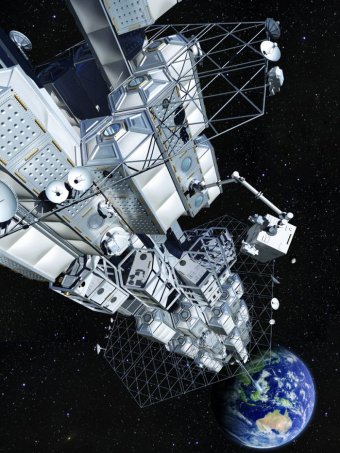
Credit: Obayashi Corporation
For years, there’s been all sorts of conjecture about creating an elevator to space. Why bother with rockets when space comes to you at the press of a button? It’s relatively cheap, efficient and kind of cool. NASA’s been tinkering with this idea for some time now, even offering a competition to intrepid folks willing to come up with a winning design.
In the meantime, a Japanese construction company, Obayashi, plans to have one functioning by 2050. Thanks to the use of carbon nanotechnology, it plans to begin construction somewhere around 2030. Extending 96,000 kilometers in space, it will provide an economical alternative to traditional launch-based technologies (otherwise known as rockets).
Considering what rockets cost to build and launch, it’s expected to be quite a savings in both time and resources. It is expected to transport up to 30 people to a space station and will take seven days to reach it.
From there, getting to the moon with the sky taxi should be a piece of cake. So when you next hear Frank Sinatra croon, “Fly Me to the Moon,” perhaps you’ll know what he was talking about. Who knew that man was such a predictor of the future of space?
Here’s a video thanks to the Australian Broadcasting Corporation that’ll give you an idea of what to expect. Watch for yourself!

The New York Times had an excellent article on the possibilities of life Out There. You know, all that space that the universe occupies. According to Carl Sagan, there was no reason not to expect life that was comparable to humans. But if you asked the competition, evolutionary biologist Ernst Mayr, we were it. Sure, it was reasonable to expect primordial soup in other locales, with perhaps a few vegetables thrown in for variety, but Mayr was steadfast in his beliefs that the chances for humanlike life anywhere but here was slim to nil.
Naturally, there’s also that school of belief that attests to aliens living among us, including the abductees who’ve been tested and probed. Those unexplained sightings of strange ships hovering over dark highways in remote locations – that can’t be fake, eh? There has to be something real under Area 51, right? After all, why do they protect it so fiercely?
If you ask me, I’d bet the rent on life existing outside our little blue dot. Compare it to the lottery. The higher the stakes, the more players become involved. Eventually, a number’s picked and a winner is paraded before cameras as the newest bazillionaire. On occasion, though, there’s more than one winner, and regularly three or four. I’m no mathematician, but what are the chances that several people will bounce into the local gas station, drop $20.00 on gas and another $3.00 bucks for a few Powerball tickets and all come out winners? It happens. So why not expect life on other planets?
Carl Sagan maintained that sound waves generated from TV and radio drifted out among the stars would signal to intrepid space voyagers our existence. That was detailed in Contact. Those sound waves possess properties that cause them to stretch and grow as they wander further from their source. By the time those waves are detected, what discernible information remains attached to these signals would be challenging to interpret. But then again, the right exoplanetary scientist might find them an intriguing prospect: thin signals meaning what? A project to research, to turn heads into another direction to discover their source? Our planet, uncovered at last?
What’s to say there isn’t a planet with inhabitants who share the dreams of finding others, only to be told the possibilities are so incredibly remote it isn’t worth a bother?
Here’s how I see it: out there, far from Earth, a soul ponders what bioforms rose and prospered elsewhere in the abyss of space. Technologically advanced to send out space probes, this soul launches a machine capable of seeking clues, if not evidence. Time passes, the soul dies, but other scientists take this soul’s place and keep on with the vigil. Eventually, the machine wanders so far away from its home planet that even its trail of crumbs grows cold. After a great deal of time, the machine is lost to memory and passes into legend, but the language on the foreign planet evolves to the point where even the legend transforms into a mystery and eventually forgotten. Meanwhile, life on that planet succumbs to its own evolution as its inhabitants face other issues that seem more pressing or trivial, but interest in further explorations has shriveled as it’s become necessary to focus on the lack of rain, food, or a dwindling resource that is elemental to the stability of life on said planet. Or, life for the other planet’s inhabitants is fulfilling, and therefore interest plummets because all needs are met and exceeded. Curiosity fades as the inhabitants indulge in The Good Life and place high importance cultivating perpetual happiness.
On a peaceful September morning, blue skies except for drifting patches of cumulus clouds, a flash streaks across the sky. Whatever caused it crashes into a suburb of a medium-sized city, resulting in a fair amount of damage to both the landscape and the object. Upon cautious examination, its solid core leads Earth scientists to believe it’s not merely silicon. Placed in the hands of a particularly observant scientist, a barely imperceptible vibration reveals a secret only a sensitive hand would notice. “Hey,” says the Earth scientist, “I think we got something here…”
No alien spaceships, no apocalyptical force, only a simple device, badly damaged and time-worn, offers a clue to a glorious civilization similar to our own, whose own culture is seemingly lost to the wastelands of space and disbelieving souls.




















 Moon, Stars and Beyond
