Here’s another wonderful video from Dennis Overbye at TheNew York Times. In it, he explains how time and light partner up to offer a show from nature centuries after it occurred.
Light, in space, is literally a living memory of events long past. There’s a profound statement at the accompanying article’s end, stating that even the light on our face shine forever.
Can you imagine? That glorious day at the beach where you smiled at the sun as it reflected on the waves and your face? That’ll live on, in the shape of light rays. And so, whatever light touches, it has the ability to record and send off our particular experiences. Using light to record humanity? There’s been speculation with sound waves and how others out there will find us via our words, sounds, broadcasts. How would they make sense of our pictures? They’d arrive apart, since light travels so much faster than sound ever could.
Now imagine if both the sound and light waves intersected, but with completely different meanings. Light from the 16th century paired with sounds from this one – this jumbled mess as message. Who would read it? How might it be interpreted?
Light is absorbed when it encounters obstacles, such as black holes. Light waves, from a fairly concentrated source on Earth traveling outward, face the possibility of reaching entirely different destinations. Some of those particles risk absorption, but others fly free. A patchwork image received by an off world interpreter might wind up with a Swiss cheesy image not entirely accurate of what it was meant to represent. Perhaps, too, that’s what we might receive here at the home planet.
Darkness is the absence of light. What gives some light waves the ability to survive while others terminate, creating darkness? Or is darkness merely another form of light? Is it light that the eyes on this planet have not evolved to discern? What forms out there might interpret our version of light as darkness?
Just a little something for your minds to unravel as you attempt to rest your weary brains for the night.
Gretchen Weerheim and sister Gwen Jones with some familiar friends made entirely of Legos
Lord, it’s been hard to keep up with this blog when I’ve had so much going on in my personal life.
Summers, on the whole, are meant for enjoyment. Mine, however, consists of closing chapters and starting new ones. On the brink of Summer 2014, my mother passed away. My father, who has Alzheimer’s, deeply grieves her loss. After 60 years of marriage, that’s not hard to grasp. He refuses to leave his bed, and when he does, it’s for brief spells only. My sister and I have been taking care of him in a tag-team fashion. We’ve had to face some ugly realities, such as selling his house and placing him in smaller quarters. We refuse to place him in organized, institutional housing and evaluating alternatives comes at a cost – financially and otherwise.
All this stress really shut down my creative mind to the point where even pondering what to put down in both a novel I’m working on plus this blog made me feel guilty. I’d sit down, armed with coffee and good intentions, only to stare at the screen and wind up reading anything from The New York Times to The Comics Curmudgeon.
Last week, after a long day tending to my father and his house, I sat down at my desk and once again, grew despondent. Nothing. The sound of crickets outside reflected the activity in my brain. Seeking inspiration, I read through my older blogs, trolling for ideas, thoughts, encouragement.
I found it – from two fellow bloggers who comment regularly on what I manage to write.
Among my archives I reread “The Plot Thickens,” in which I describe an exoplanet first thought to exist and then suddenly, it vanished. D.R. Sylvester positively commented on a description I gave regarding an astrophysicist (“red-headed ball of fire”). Then Hugh Roberts of Hugh’s News and Views commented on how another brief posting of mine, “A Gorgeous View of the Universe” inspired him. Feeling somewhat more encouraged, my mind took a right turn back into my family and how they shaped me into the writer I’ve become.
An earlier blog, “Mom, Up With The Stars”, described my mother’s influence on my love for sci-fi. My father, the middle child out of eleven, born shortly before the stock market crash of 1929 and whose family fell victim to the Dust Bowl of the 1930s, had inspirations for writing. Dad had a way with words and loved good stories, especially history. Both parents encouraged my sister and I to express our artistic ways, no matter what form they took. Gwen Jones, a best-selling author whose titles appear on the Woman’s Fiction and Romance listings, encouraged me to move my writing talents from technical/educational to science fiction. Thanks to her, I belong to Liberty States Fiction Writers Group, a highly-regarded group consisting of many best-selling published writers in all genres, plus those who are well on their way. Andrew, my husband, is probably the biggest fanboy ever. His multitudes of sci-fi novels fill many of our shelves and I deeply value his input and opinions. He’s a great plotter, too.
With this basket of goodies at my table, I chose to take another approach to writing. With one novel finished and another underway, I’d thought I’d create a side project, if you will. You might notice it listed at the top of my blog – a new page called “Incurable Mistakes – A Serial Story.” Using D.R. Sylvester’s suggestion that the red-headed ball of fire astrophysicist plot line might actually work, I bore that in mind as I sat in my father’s home and began telling a tale. I invite anyone out there to come and join me. Read along and if you have a great suggestion, send it on and I’ll work it in. Call it a group novel. The only thing I haven’t figured out (haven’t tried, actually) is how to make subpages for new chapters, although I’m sure it’s easy.
I’m not making promises, but I will try to slap together 500-1000 words a week. Anything readers of this blog can add to the pot might make this stew tastier!
What is it about the name Lucy that translates into a woman of exception?
My first exposure to anyone named Lucy appeared like this:
Thanks to “Peanuts” and Charles Schulz
Though depicted in cartoon form, Lucy was mean, authoritative and plain bossy. Her combative side played against her profession as a therapist, although her rates were rather low to reflect the acidity of her plain-spoken advice.
Credit: “Peanuts” by Charles Schulz
Don’t be fooled by her placid expression – this girl ate boy’s psyches for lunch!
Somewhere along the line, well before the above Lucy’s time, another individual bearing the same name roamed the planet. None of us were around to duck her left hook or receive any sort of constructive advice from her jaded mind. This particular Lucy avoided verbal battles and stuck to those pertaining to self-preservation.
Credit: University of Minnesota at Duluth
Lucy’s daily life revolved around the basics: food, water and trying not to be eaten by hungrier life forms. Her ambitions weren’t to solve ancient mysteries, yet she became one for moderns to discern. Little did she realize she’d become a celebrity in scientific circles; the most she probably hoped for was to make it to the end of each day in one piece. Still, I can imagine her fighting off both her kind and others who might interfere with her general happiness and well-being. Take a look at that face: is that a smile or a taunting smirk?
This brings us to yet another Lucy:
Credit: “Lucy”, Universal Pictures
As you can see, this Lucy beautifully combines the self-preservation instincts as our ancient Lucy with the no-nonsense style of “Peanuts” Lucy. As the unwilling recipient of a manufactured illicit drug from a notorious Asian drug god, Lucy finds herself evolving rapidly through the 100% capacity of her brain. All sorts of neat things happen, both for good and ill, but she makes it plain that once she’s got this drug in her system, she’s driving the bus and she’s not waiting for anyone to get on.
My husband Andrew and I went to our local dodecaplex to see “Lucy” for ourselves the other night. Eschewing overpriced greased popcorn, we scored prime seats and sat through the merciless chain of dull trivia slides, irritating adverts and banal animated rules and regs for the theatre. As the lights grew dim, we were subjected to the endless onslaught of trailers, including the truly frightening one for “Fifty Shades of Awful” (one look at the male “romantic” lead leaves you questioning: Him? Really? That’s the best casting could do? Hint from a woman to guys: DON’T take your favorite lady to see this on Valentine’s Day when it opens. Trust me. Flowers and chocolate are a far better choice).
Just short of a revolt from the audience, the film finally started. I’ve always like Scarlett Johansson and she seems to do well with sci-fi roles that have a bit of bite to them. Though she started off a bit weak, her performance strengthened as the film went on. What I didn’t like about the film was how it expected viewers to take a real leap of faith about how the plot unfolded, and just expected you to believe what was happening required little or no explanation. Although that could be said for many sci-fi films, on the way home Andrew and I laughed about how aspects of the plot unfolded without regard to plausibility. Still, we liked it a lot, it was entertaining and fun and I’d recommend it.
Besides, SJ’s Lucy gets to meet her ancient predecessor. Shame there was no mention of Charles Schulz’s creation.
The New York Times had an excellent article on the possibilities of life Out There. You know, all that space that the universe occupies. According to Carl Sagan, there was no reason not to expect life that was comparable to humans. But if you asked the competition, evolutionary biologist Ernst Mayr, we were it. Sure, it was reasonable to expect primordial soup in other locales, with perhaps a few vegetables thrown in for variety, but Mayr was steadfast in his beliefs that the chances for humanlike life anywhere but here was slim to nil.
Naturally, there’s also that school of belief that attests to aliens living among us, including the abductees who’ve been tested and probed. Those unexplained sightings of strange ships hovering over dark highways in remote locations – that can’t be fake, eh? There has to be something real under Area 51, right? After all, why do they protect it so fiercely?
If you ask me, I’d bet the rent on life existing outside our little blue dot. Compare it to the lottery. The higher the stakes, the more players become involved. Eventually, a number’s picked and a winner is paraded before cameras as the newest bazillionaire. On occasion, though, there’s more than one winner, and regularly three or four. I’m no mathematician, but what are the chances that several people will bounce into the local gas station, drop $20.00 on gas and another $3.00 bucks for a few Powerball tickets and all come out winners? It happens. So why not expect life on other planets?
Carl Sagan maintained that sound waves generated from TV and radio drifted out among the stars would signal to intrepid space voyagers our existence. That was detailed in Contact. Those sound waves possess properties that cause them to stretch and grow as they wander further from their source. By the time those waves are detected, what discernible information remains attached to these signals would be challenging to interpret. But then again, the right exoplanetary scientist might find them an intriguing prospect: thin signals meaning what? A project to research, to turn heads into another direction to discover their source? Our planet, uncovered at last?
What’s to say there isn’t a planet with inhabitants who share the dreams of finding others, only to be told the possibilities are so incredibly remote it isn’t worth a bother?
Here’s how I see it: out there, far from Earth, a soul ponders what bioforms rose and prospered elsewhere in the abyss of space. Technologically advanced to send out space probes, this soul launches a machine capable of seeking clues, if not evidence. Time passes, the soul dies, but other scientists take this soul’s place and keep on with the vigil. Eventually, the machine wanders so far away from its home planet that even its trail of crumbs grows cold. After a great deal of time, the machine is lost to memory and passes into legend, but the language on the foreign planet evolves to the point where even the legend transforms into a mystery and eventually forgotten. Meanwhile, life on that planet succumbs to its own evolution as its inhabitants face other issues that seem more pressing or trivial, but interest in further explorations has shriveled as it’s become necessary to focus on the lack of rain, food, or a dwindling resource that is elemental to the stability of life on said planet. Or, life for the other planet’s inhabitants is fulfilling, and therefore interest plummets because all needs are met and exceeded. Curiosity fades as the inhabitants indulge in The Good Life and place high importance cultivating perpetual happiness.
On a peaceful September morning, blue skies except for drifting patches of cumulus clouds, a flash streaks across the sky. Whatever caused it crashes into a suburb of a medium-sized city, resulting in a fair amount of damage to both the landscape and the object. Upon cautious examination, its solid core leads Earth scientists to believe it’s not merely silicon. Placed in the hands of a particularly observant scientist, a barely imperceptible vibration reveals a secret only a sensitive hand would notice. “Hey,” says the Earth scientist, “I think we got something here…”
No alien spaceships, no apocalyptical force, only a simple device, badly damaged and time-worn, offers a clue to a glorious civilization similar to our own, whose own culture is seemingly lost to the wastelands of space and disbelieving souls.
In addition to my regularly-scheduled blog entries (which, I admit, have been rather slim as of late…sorry!), I’m dishing up a delicious serving of quick but quotable links. That is, once you take a look at what I’ve got here, you’ll be talking about them to your friends, family and blogosphere buds.
So without further ado, here they are:
1. This comes via the website Cool Infographics, which offers a wide selection of ordinary data magically transformed into wonderful graphics detailing ideas, thoughts, facts and other items of note. Randy Klum is the author of both the site and the book of the same name. The link below details 50 years of visionary sci-fi computer interfaces, or, in other words, television shows and movies’ predictions for our digital futures, starting with “Lost in Space” and continuing onto the movie “Oblivion.”
2. There’s a whole batch of brash storm chasers following tornadoes, or hurricane hunters that fly planes directly into the eye of a hurricane to see what’s going on inside. I’ve witnessed tornadoes forming myself (not by choice) or totally nasty thunderstorms approaching while driving. Now imagine yourself aboard the Cassini spacecraft and zipping around Saturn. You’ve discovered a storm at its north pole unlike any other. Click here and prepare to be amazed…
3. Here’s a followup to the blog a wrote a few weeks ago regarding the zombie spaceship otherwise known as the International Sun-Earth Explorer-3, or ISEE-3. Unfortunately, the hardworking citizen scientists were unable to steer the craft into a direction that would bring it closer to the moon. However, I highly recommend that you not cheat yourselves out of this remarkable adventure and learn more about its extended mission and those that made it possible. Visit its website here.
4. The Martian Confederacy by Paige Braddock and James McNamara is a relatively new online graphic novel. It’s the year 3535 and three outlaws struggle to save Mars, once a former vacation destination. Read it!
5. Thinking about the perfect Christmas present? You can’t go wrong with a genuine lightsaber! Pick out the perfect one for your favorite Jedi knight right here.
Used to be that naming planets was a fairly simple task. The Ancients looked up towards the skies, observed that a handful of stars travelled across the sky (and, in fact, planet means “wanderer”) and gave them a suitable name that reflected what they saw.
For example, Mars, glowing red in the heavens, was named for the Roman god of war. And it wasn’t just the Romans who considered this planet the embodiment of conflict and challenges, many cultures and their languages also saw fit to give it this distinction. The Greeks called it Ares, Hindus call it Mangela, Hebrews call it Ma’adim, in Sanskrit it is known as Angaraka, and in Babylon one would notice the rising and setting of Nergal.
With the advent of stronger telescopes, more planets within our solar system were discovered, though not bright enough to spot with the unaided eye (mostly – if you know where to look on an incredibly clear night in the middle of a very dark, dark field with absolutely no chance of any interfering light from any source, you might see Uranus, but that depends on other conditions, too). I’ve seen Jupiter’s four bright moons, through a telescope but with my own eyes, too (but you have to cover up Jupiter with a magazine to see them; it’s much less of a challenge to spot them even with birding binoculars or a decent pair of opera glasses).
Nowadays, we have a problem of riches. Thanks to the hard work of astronomers, astrophysicists and others trained to observe the telltale signs of wobble and movement, there are over a thousand planets at our disposal. Sure, they’re ridiculously far away and chances are you’ll never see any of them though your backyard reflector. But you might see the star they’re rotating, and imagine what kind of life lives upon these exoplanets, as they’re called.
Do you want to blow your mind? The New York Times has an amazing interactive graphic that’ll keep you busy for hours. I can’t even find the words to describe how amazing this chart is, but if you check it out, make sure you scroll down to the end. I won’t give away what’s there, except you’ll gasp and say, “hmm! The ones found are the result of NASA’s Kepler mission that have confirmed planets rotating around stars. If you click on some of the graphics on the above link, up will come information about the planet and its sun.
Of course, it’s impossible to find appropriate names for this batch that seems to be growing daily. That doesn’t mean there hasn’t been attempts. The International Astronomical Union is sponsoring a contest for that very purpose. Have any ideas? Here’s your chance to honor a hitherto anonymous planet with a memorable, catchy handle, just as you would a baby.
Trouble is, what would the inhabitants of said world think?
Did anyone miss me? I’ve been busy with a few things, but not too busy to put pause to my daily activities and make fun of the worst that the SyFy network has to offer. And yes, I know I’m not the only one here who has commented on this very subject but…
Sharknado? Sharknado II??
Okay. It barely qualifies as anything, and I wouldn’t dignify it placing it in the same category as science fiction.
So here’s my question: Why?
There’s sooooo many sci-fi writers out there, dedicating their precious hours to composing what will shape up to be terrific stories with – gasp – plots! and yet somehow, these same writers struggle to see the light of an editor’s desk. How is it, then, that some crank hack manages to pull off not once, but TWICE a crappy story?
I speak with authority. My husband and I watched the first entry quite a while back and we would have changed the channel, but we were watching that train wreck believing it to be a parody. Sadly, we were mistaken. Embarrassed to admit our mistake, we pledged to mentioned this incident only between ourselves. The next day, Sharknado was all over the media, an unlikely success. Not in the blockbuster vein, mind you, but in the gobsmacked, godawful disbelief category. Viewers just like us shook their heads, wondering what subliminal force soaked our brains like dry sponges and wrung them dry.
Then, our worst fears took root: if once wasn’t bad enough, SyFy figured they’d give a horrid idea a second go. As if New York doesn’t have enough problems, let’s add tornadic sharks to its woes. Fear not, though, because our hero comes armed with a chainsaw once more.
Now, this entry catches the attention of The New York Times. They’re not bragging about it, natch. Their review is rather nasty…but fun. Needless to say, I skipped watching it, having busied myself with real goals and ambitions for my life.
Still, I was a tad curious.
So were the good folks at the Huffington Post. My husband Andrew thoughtfully sent me a link to Sharknado 2. The best part? It’s two minutes long and cuts right to the chase.
Kind of reminds me what Robert Rodrigues would do if he had two minutes to trash a trailer. Or film. Check it out!
I promise my next post will return to my regularly scheduled programming.
Today I attended a seminar on what could have been a rather interesting subject. In fact, I found the keynote speech to be so compelling that the workshops following that speech should have been equally interesting. My friends joined me, and we found seats in a darkened room, preparing to pay close attention to the speaker and her presentation.
And then?
Not much. I blanked out. So did one of my friends. Perhaps the subject was presented too broadly, or the speaker lacked the confidence to deliver her speech with conviction. But anyway, there we were, passing notes via our text messages, on a wide variety of commentary. Were we bad? Possibly. Were we wasting our time? Never.
See, it’s times like these that I take advantage of a darkened room and allow my thoughts to drift constructively. I spend this time constructing plot lines and allowing my imagination to transport me to places where I normally struggle when planted firmly in front of my computer. It’s my little trip to the unknown, where I explore my inner world in search of an exemplary adjective. I’m writing a book, actually the second in a series. I know exactly what’s going to happen in this second entry, start to finish. No plodding plots here, folks. That’s all squared away.
All the characters have received their job assignments. They stand waiting patiently in the wings, looking for their cues to enter the stage of pages wherein their part comes alive, ready to jump into action. Unfortunately, they have no way of articulating it. Why? Because I’m still wrenching out the exact prose their fictional lips are about to utter.
I’ve developed my craft with wit, a hint of sarcasm and a touch of irony, laced it with suspense and a hint of romance (just a tidbit, mind you, because let’s face it, characters need love too). But I simply can’t bring myself to compose dull, lifeless conversation like this:
“What’s going on, Rachel?”
“Don’t worry about it, Pete.”
Ugh.
Those two sentences are my sculptor’s clay. Those words are what the characters are thinking, but I want them to deliver them so the reader’s clinging to the book with sweaty palms, anxious to turn the page in the hopes that Pete and Rachel are going to…going to…going to…oh, my God! is THAT what’s up???
So as I shivered in the refrigerated, darkened conference room, I leaned back in my leatherette chair and stared into the PowerPoint presentation. I allowed Pete and Rachel to swallow me whole, as they wrestled with that dilemma that floated beyond their reach.
Here’s what came of it:
Pete glanced at Rachel, worried. “And what’s your plan, if I might ask?”
“You need not concern yourself. I’ll probably slug my fist into a few protesting jaws and guts, but beyond that, nothing worse,” she said, smiling assuredly.
Oh, there’s more, but you’ll have to find out later.
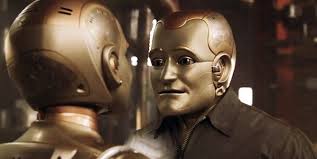
Famous actor who should have been smarter or known better
One always hears that sooner rather than later, artificial intelligence will win the battle over humanity. People will become unnecessary, robots will rule the earth and humankind will vanish with a flicker of a dying match.
It’s true. I read all sorts of articles from many sources that discuss both sides of the issue. Many valid arguments from both sides. However, I can’t get past one thing: humans build these things, don’t they? Not machines, but flesh-and-blood types, the kind that need air to breathe and run on food instead of…well…whatever it is that AI runs on.
To be honestly, I’ve yet to see a real valid example of a machine building a machine smarter than it. In fact, I’ve yet to see any sci-fi out there regarding a droid, robot, gizmimee or quelnodder, screwdriver in hand, lifting the lid off of the head, chest and guts of a counterpart, carefully placing a chip inside and closing it up, then miraculously watching that God moment when all becomes too real and rises up to become the conquerer of the universe.
Droids/Robots constructing improved units also presents another item for discussion: why would it? What does a D/R have to gain by creating an improved version of itself? That improved version might notice its creater’s a bit dimmer than it, find the kill switch and be done with it. True. that can be part of the program and if the God D/R had any sense, it might write a code that includes a directive a al “I, Robot”, in that “do no harm” is a real and true order. Even that statement up for interpretation. If the God robot wants to kill its progeny, it’s preserving its own life with the successive, smarter D/R catches on that it has one chip up on its Daddy.
Bearing this in mind, why would a person create an object than can outsmart us? Frankly, humans are too clever for their own good to do this. First of all, we’re competitive. Egos are sensitive enough as it is. Some of you might remember Garry Kasparov losing to IBM’s Deep Blue, after beating it previously. He didn’t take it well at all. And then there’s that “Jeopardy” match with mere mortals. Although that took some doing, again, people got the short end of the stick.
So apart from these novelty versions of AI, what else can we cook up that won’t kick our pride in the shins? No one’s going to brag over their vodka gimlet and state to the bartender, “Say, want to hear the latest? Remember that droid I slapped together in October? You’re not going to believe this. It approached my boss, got my job – AND – a raise! Then, it locked me out of my office, drained my bank account and ran off with my spouse! I’m lucky I had enough chump change to buy this drink.”
Of course, we all know that drink was expertly served by none of than Bob the Botender, programmed to sympathetically listen to life’s ups and downs, collect tips and cut you off when you’ve had a few.
Mars, the alluring tempter of a planet, now exists in map form, easily accessible at the touch of a computer key. That’s it, just above the copy of this blog post. As you can see, there’s peaks and valleys, plus polar ice caps. From the shape of things, one can imagine where water might have flowed and accumulated.
Here’s another view: rotating Mars
The last map was created in 1987, when technology and resources were scant and crude, compared to today’s standards. Previous maps consisted of data taken from Viking probes and other sources. What made this latest incarnation possible is the use of the Mars Global Surveyor and the laser altimeter, which bounces up to 600 laser beams to the surface. Such details, as ages of rocks, were gathered from these sources.













 Moon, Stars and Beyond