Archive for the ‘Science Fiction’ Tag

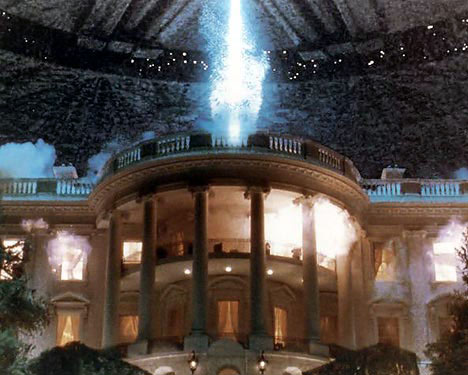
Scene from the movie, “Independence Day”
Hooray for America! Tomorrow is Independence Day, otherwise known as The Fourth of July. It’s a big deal in this part of the world, mainly because we get the day off, drink beer, eat BBQ and shoot off fireworks in the hope that the cops won’t show up and have you arrested for setting fire to the neighbor’s roof.
July 4th has always been about fireworks of a sort, especially when the aliens come and visit. You never know what they have up their sleeve, those sneaky gits. Take, for example, the well-regarded film, “Independence Day.” As pictured above, the aliens had plans about freeing Americans from the slinky tethers of the White House, because they knew to arrive there and blow it up. Out of all the grand buildings dotted across the USA, the aliens carefully researched the most appealing targets and thoughtfully removed them from the map. Intentionally, aliens freed ordinary Americans from the drudgery of law, order and the relative stability of a democratically-elected government…or made a statement about the Tea Party and the Koch brothers.

“Independence Day” Alien
Aliens, on occasion, are sticky. I could name a whole bunch of films that depict our off-world colleagues as drippy, goo-piles that slurp and ooze. It’s never explained why, but I’m certain if a human should, on the brink of death at the alien’s hand, mentioned that their acceptability rate would skyrocket if they only dried off a bit, then the inevitable all-Earth obliteration would be so much more palatable. So here’s our friend that I’ll name Indy, dripping. It could be that the crack in his skull is releasing vital body fluids, or it secretes when harmed/threatened. Either way, it’s gross. Stop it, already, before your cred plummets even further!

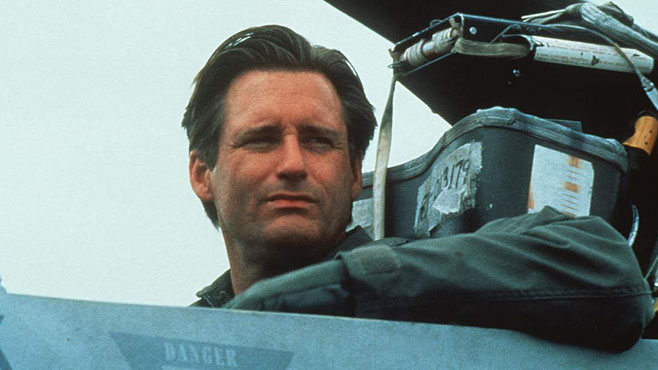
Bill Pullman as President Thomas J. Whitmore, in “Independence Day”
Often, American presidents are played by grey-haired but dignified old(er) men. Who wasn’t impressed with prime-of-his-life, hunky Bill Pullman as the ex-Air Force pilot tackling those nasty aliens? Instead of sitting on his buttocks complaining about the state of things, he went out and did the job himself, just like Obama does when he gets sick of all that congressional shilly-shallying. And yes, he didn’t quite get rid of the problem (that was left to Randy Quaid, possessor of a problematic off-camera life), but gee, doesn’t he look hot just for trying?

Brent Spiner as Dr. Brackish Okun in “Independence Day”
What sci-fi film would be complete without data…or Data? Playing against type, Brent moved away from his android role in ST: TNG to this guy. Here’s something a few of you might not have known: around the same time (or at least the same decade), he appeared on Broadway in the play, “1776,” which is also about American independence. I went. Even took my parents. And damn, he was good. The man can sing!

Swaggering heroes Will Smith and Jeff Goldblum
Because this is an American film using an American holiday as its title, America is entitled, so to speak, to claim the victory. While three-quarters of the planet’s wiped out, Americans came in and saved the day! Woo hoo!
So what are you going to do tomorrow? My suggestion: watch completely predictable, over-the-top, stereotyped-rife Independence Day. What better way to celebrate?
And you don’t even need to be an American to do so.

Credit: Andrew Chattaway – Moon over Devil’s Tower
With kids and cute aliens helping out each other again this summer, I’d thought I’d focus on a few past endeavors by Hollywood that exploits children for the greater good of the alien’s quest to rule the planet, or at least have some practical use for it. Generally, all the aliens wind up doing is using the kids (or their friends/family) to stick it to the man, break laws, wreak havoc and make a positive, heartwarming impression on the kid(s) that will guide them through the rest of their lives.
Quick! Name five films wherein aliens and kids meet up, bond and learn important life lessons that will guide them through their formative year and beyond. Name two wherein Devil’s Tower figures prominently.
Drawing a blank? Here’s mine:
1) E.T. – An obvious choice, eh? Such a story: a lonely kid from a broken marriage meets up with an ugly-but-cute alien who is also a fugitive from those nasty government people. After a few tentative missteps, alien and kid learn a few things off of each other and discover that being different has its assets. Older brother totally embraces the outlaw aspect of harboring said fugitive, gets friends on board to skirt the law after a scary brush with it, then everyone goes on a quasi-high speed dodge-’em bike chase to lose the cops and send E.T. back to the planets. It’s a heartwarming tale meant to leave the viewer with a warm, glowing feeling…just like the pulsating chest of E.T. Kids also learn the value of sticking it to The Man by learning that all government officials are evil, hostile sorts who have absolutely no business wondering just exactly what kind of being from another planet goes after young innocents and teaches them how to get away with breaking nation security protocols.
2) Close Encounters of the Third Kind – Kid actually gets abducted by stereotypical, pale verdigris aliens and winds up in a ginormous ship from which mobs of abductees are eventually unloaded back to the planet where they were first plucked. It’s assumed they’ve been probed, charted, analyzed and documented for future use. Cherub child, abducted in early scenes of film, runs towards Mommy (who’s been skirting the law herself trying to get the kid back) once he’s set free. In the film, it’s mentioned that some have an unusual force beckoning them towards the expected alien landing site. Apparently, they were invited to attend, and the calling card is an unshakable mental image of a strange-shaped mountain located somewhere in the American West. Well, the kid was dragged through a doggie door. I get the distinct impression it wasn’t his idea to come to the party or he even had the faintest idea of what Devil’s Tower even was, where it stood or why he, of all kids, was selected for this particular space venture. Apart from being scarred for life with post-traumatic stress disorder from his abduction, we know that child is going to be just…fine…
3) The Day the Earth Stood Still – Little Bobby Benson’s Dad died in World War II, and Klaatu/Mr. Carpenter’s just the guy who’ll show him not only how to improve his math skills, but nuclear bombs are a bad idea because if anyone on Earth’s ever going to use them, Klaatu’s going to teach all those naughty, nasty Earthlings a big lesson they’ll never forget. The government’s going after Klaatu, so he uses Bobby’s mom Helen as his ticket to freedom and get back to Gort and that big ship sitting on the President’s Park ellipse. Kids learn that while they might be able to skirt the law together with their new-found alien friend, their parents might.
4) Mars Attacks! – Now, these are teenagers that wind up being victorious in the end. What’s cool about this one is Natalie Portman, as the president’s daughter Taffy Dale, winds up giving Lukas Haas, another teenager, the Medal of Honor, all because Slim Whitman yodeling makes the Martians heads explode. There really is no law to skirt here, but if nothing else, the cheese factor’s on overload, with Tom Jones providing plenty of it for the film. Natalie Portman would go on to play Padmé Amidala in the “first three episodes” of Star Wars films.
5) Paul – This one’s a bit of a stretch, but Paul landed on Tara Walton’s dog, who was stigmatized her entire life and called a freak because she met a real alien and no one believed her. A child at the time, she suffered insults from other kids thinking she was a reclusive nut case, which she did become. In the end, we find out that she isn’t really skirting the law, only trying to have a wonderful adventure to make up for the rotten hand that Paul dealt her by helping him escape the G-men out to nab Paul for the Big Guy. One can only imagine the misadventures that lie ahead for both she and her old friend, Paul. And yes, they go to Devil’s tower, where everyone know aliens go for a good time.
So. What’s your favorite child & alien film?

Don’t tell me you have seen every single episode of The Twilight Zone at least a million times. The show’s like crack; after a few seconds upon landing on whatever channel the show happens to be airing, it becomes impossible to turn off. There must be scientific studies lurking about that analyze the particular section of the brain that demands one watch TZ without interruption. Or, diabolically, Rod Serling placed subliminal messages within the episodes. Viewers trance out, drool a bit, say to themselves, “So that’s where William Shatner got his start!” (Hint: John Lithgow reprised one of the roles, but WS actually starred in two episodes)
I attribute my own particular attraction to this show when my age came in single digits. At that point, most shows were in color but still watching the black and white ones wasn’t unusual or weird. TZ didn’t make sense and that was fine by me. Later, in college, my friends and I stayed up well past midnight to catch episodes and quasi-pretend to be surprised (impossible, since the show was fodder for our misspent youths) or comment on the double meaning of the episode (“To Serve Man”). Even now, during marathon showings, I manage to sneak in a little quality TZ time and hope to catch one of my favorite episodes.
After my Mom passed, inevitably we had to sort through her drawers. That’s never easy. Personal belongings are an assessment of one’s life; items chosen by Mom had purpose and meaning. A favorite scarf, her mother’s wedding ring, photos of people I’ll never meet whose names are lost to time – all jammed without mercy in her vanity top drawer. Major natural disasters wouldn’t have budged the contents. Mom kept all her accumulated possessions bound together like old friends who see no reason to part company.
One afternoon, I chose the unwieldy task of sifting through her clown car dresser. I say this because I marveled at the amount of stuff she shoved into it. The more I grabbed at old clothes, hats, papers, candles, etc., the more intrigued I became. So tightly packed had everything become, items towards the back refused to relinquish the turf they so jealously guarded over time.
Nearly emptying the bottom shelf, I came across a cardboard box, slightly smashed and held together with an ancient rubber band. Since I had no clue what was inside, I opened it. Within the box rested a collection of miniature masterpieces, lithos of relatively unknown artists combined with a few superstars. I shuffled through them, saw the obligatory Van Gogh “Sunflowers” plus a few other Greatest Hits.
And there it was: Pig Girl.
Glancing at me, her brown eyes hinted at nonchalance. Pig Girl appeared as a young woman, possibly a teenager, with a round face and pug nose, sassy upturned brown hair, charming white hat, her collar tied with a bow tie that seemed to float in a sea of crisp whiteness. She wore a brown outfit suggesting a school uniform.
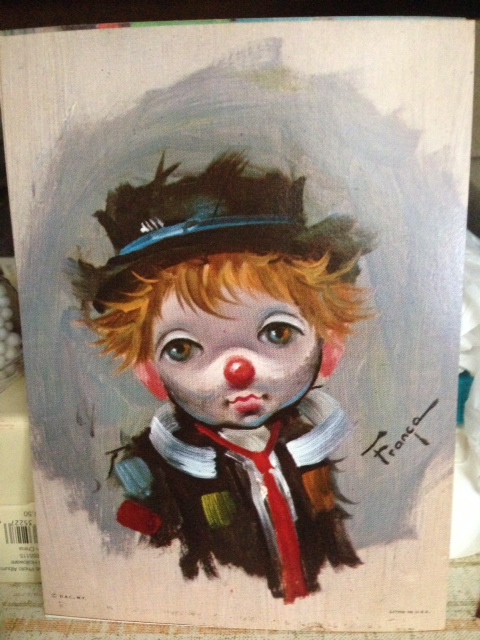
It hit me then: this one’s from that Twilight Zone episode, “The Eye of the Beholder.” In it, pig people valiantly try to plastic surgery-ize a gorgeous woman, regarded by the Piggians as hideously ugly. Perhaps the young, confident Pig Girl lifted herself straight from that episode. Charmed her way into the studio of the artist (Frango? Franga? Franca?) and insinuated herself into the Masterpiece collection. She had a partner, too, a clown boy. No siree, Pigitty wasn’t going through life on this planet alone. She had this fella for fun times:

Hobo-clown, sporting a look of resignation on his face, seems determined to find a purpose despite his genetic mutation. Both he and Piggity survived the DNA splicing of human and pig, they planned to make the best of it and damned be the world.
Can you imagine what might come next if these two produce an offspring? What horrors might come of that?
I closed the box and its unsettling contents rested once more in their dark shelter. I must admit, their presence haunts me still. Strangely, I can’t find Piggity. She seems to have vanished. Kind of scary, don’t you think?
So here’s a word of warning: when a parent dies, use extreme caution going through their former possessions. It can be a real trip through…The Twilight Zone.

So there I was, a little kid, really, laying on my stomach on the living room floor. That’s how the small set viewed television, at least back then, when TV sets weren’t flat screens but part of the furniture. This show, Star Trek, was on and Mom was glued to it. Only a few years later, she’d do the same with Tom Baker’s version of Dr. Who.
Every Saturday afternoon, she’d turn on Channel 17 in the kitchen and watch whatever horror movies they happened to play. I’d turn on the set in the living room and watch from the couch. Mom peeked up from the ironing board, giant pot of dinner or pile of something she happened to be tending to at the time, and me, well, I’d be there, glued in stupefied fascination over the ridiculous plots. I mean, come on. A giant moth taking over a city? I never could get used to lips not moving in sync to the voices that never quite seemed to match up to the person speaking them.
Still, countless Saturday afternoons with Mom went by, watching an enormous man tangle with electric wires as his former girlfriend implored him to stop, or yet another man shrunk down shorter than the grass he hid in contemplating the stars. Why were the victims generally men? Sure, occasionally you had the disfigured, angry woman out to kill whomever did this to her, but on the whole, it was some luckless fellow falling down a hole, getting sprayed with a mysterious liquid, blasted by X/gamma/nuclear/unknown rays and having his soul wrenched from him as his body contorted/transformed/vaporized into an unrecognizable mass that wreaked havoc in the nearest city…and always a city.
Mom’s fascination with this stuff naturally influenced mine, except I developed a liking to those story lines that involved spaceships, aliens, misguided off-world adventures, and the like. I still think one of the best vintage sci-fi films is The Day The Earth Stood Still (the one that stars Patricia Neal and Michael Rennie), and so did Mom. Klaatu had it going on, and I thought he should have taken Patricia Neal with him, maybe the kid, too. That would have been a good story. Neither Mom nor I didn’t think much of the remake with Neo, but it did have its merits.
What Mom didn’t find to satisfy her thirst for science fiction adventure, she found up in the evening skies, when she was so inclined to peek at them. By the time I was in the sixth grade, I spent many an hour glancing up at them and I always told her what I saw, even showing Comet Kohoutek to her (a MAJOR disappointment). Occasionally a planet might wander by or an eclipse might occur. Come to think of it, my first total eclipse of the sun was shared with Mom, back in the 1970s. How amazing that in the afternoon all the lights went on in the street, the birds stopped singing and a few bright stars appeared as the sun played coy with the moon. We stood outside, afraid to look at it but in the end taking a quick peek during totality, gasping at that miracle of nature.
As years went by, my mother never lost her love for stuff not readily explainable, either via television or the movies. Once, she and my father even saw what they believed to be several UFOs flying over the coast, where they lived. That confirmed their belief by hundreds of reports the next day, covered both in the paper and on the morning news. We watched as the real Enterprise went piggyback on a plane, then as all the space shuttles, SkyLabs, ISS and anything else that left this planet went up and aided the Earth’s population, scientific and otherwise, to explore whatever lie out there and beyond.
On May 24, 2014, my mother went up there in the heavens to become one with the stars. I’d like to think she currently resides there, since she took so much interest in them. She had a very peaceful journey, laying down to take a nap from which she never awoke. There was nothing truly wrong with her, said the doctor, apart from it was her time. Mom had 85 action-packed years and I’d like to think they were all incredibly interesting ones. She leaves behind her family, terribly sorry to see her go and missing her every day.
I couldn’t write a single word of this blog until now. Nothing came to mind. Then, just like magic, the memories of how I’d laugh and joke with Mom over those vintage Saturday afternoon sci-fi groaners we used to watch together popped into my mind.
I’d like to think Mom put that there.
Bye, Mom! I’ll see you in the stars…

Every night, when I look up at my familiar winter friends, I have to remind myself they’re long gone.
At least from my perspective, anyway.
Here’s what I see: Orion charges in a dark field with his faithful dog. Is he hunting the hare or the bull? Do his friends, the Gemini Twins, help him catch his prey? Or is he on the banks of Eridanus, awaiting an enemy?
Here’s what is: The light that shines from those stars has left so many years ago, one can only make predictions where they’re located today. Based on red shifts and calculations, it’s not too difficult to determine where the stars in the above constellations have shifted.
Here’s what makes me wonder: What was the world like when the light from Rigel (the right foot of Orion)?
In order to consider this, one has to realize that the light from Rigel left 500 years ago (it’s 500 light years away). That would mean in the year 1514, light particles separated themselves from this bluish-white supergiant, hurtled through the void of space, penetrated the Earth’s atmosphere and landed in an observer’s field of vision.
Copernicus, in 1514, had his own questions regarding the sky above him. During that year, he made his first observations of Saturn. Data gathered from this and other observations of Mars and the Sun led him to discover the earth’s orbital eccentricity, or deviation from a perfect circle. He also was of the radical opinion at the time that the Earth was not in the center of the solar system. Ptolomeic theory, officially approved by the Catholic Church and accepted as the only explanation for things planetary and universal, also decreed that orbits were perfect circles, and, as an added bonus, the Earth was indeed the center of the universe.
All this must have seemed like great science fiction to the ever wise fathers and hierarchy in Rome. Though Copernicus took minor orders in the Catholic church, his faith in God must have been piqued when he made his discoveries. Imagine that all he ever believed was suddenly called into question because of the methodical works and meticulous observations of the nighttime sky. What to do? Believe what nature tells you? Or what the Catholic Church orders you to believe?
Imagine the conversation Copernicus held with colleagues, who presumably believed he might be onto something. Now try telling that to the village priest, who might have considered him to be the village idiot or instrument of the devil. “Say, guess what?” Copernicus’ conversation might have began. “I found out we’re not in the center of the universe any more! And guess what else? Earth rotates around the sun, not the other way around! How about that? Like, OMG, that’s a BFD!”
For the average citizen in 1514, who might not have had a grasp of scientific principles, this was blasphemy, pure and simple. But the thing was, Copernicus only shared this info with a handful of people. It wasn’t until years later, as he neared death, that his work on his findings was published. Others, such as Galileo, took the heat for this and other discoveries until science finally raised his heavy hoof and triumphed.
There’s parallels here. What seemed so absolutely wild, even one hundred years ago, is feasible now. All because a person woke up one morning and said, “Now, what will I find out there among the stars?” It didn’t matter that the light shining on them was from 1514, or 240 BCE. Or visible from earth. That person knew the stars held secrets worth sharing, and he/she set out to tap into them.
So. Go out and observe Orion. Say hi to Rigel. Ponder all that happened in the time that passed during those 500 years of light travel. Tap into it. Take a piece with you. Take a chance. Make a change.
After all, our future shoots right out of our past.
The Future.
What, exactly, do those words mean to you?
Are you like Ted Forth, who daily registers his disappointment because he’s unable to commute by jetpack? Or that our world will be inhabited by aliens? That our society will take a sinister turn, only to be run by androids, or a version of them, such as in “The Matrix?” Or the world will be hot, starving and few of us will lead lives of our own choosing, such as in “Logan’s Run” or “Soylent Green?”
My take on the the future’s pretty simple: it’ll be pretty much the way it is now, only different.
We’re still going to get up in the morning, complain about the way things are and discuss the weather. Some will fall in love, choose to share lives together, bear or adopt children or not. Life will be fair, or a disaster. None of that will ever change.
What will change is the method by which we live our lives. Do we integrate technology to such a degree that we can’t separate ourselves from the stack of electronics we’ve accumulated? Or do we segregate ourselves from the gizmos that govern our being?
Who governs our future? Do we sit idly by, grousing over government and those we elected, or do citizens take personal responsibility over the choices they make each time they visit the voting booth? Or do we choose to ignore our citizen’s obligation to vote and bury our heads in the sand whenever election time comes around?
Believe it or not, the shape of our future lies in all of our hands. The future is not defined by what’s going to happen to you. Your choices govern how the future will be.
Enough soapboxing.
I’d like to devote this blog to all aspects of The Future, as interpreted by Science Fiction, political developments, earth changes, society at large and whatever else comes across my mind. Some of it will be how the future looked in the past, and how our past has shaped the future. I promise it won’t be preachy or agenda furthering, just an exploration of what lies out there – including the moon and stars, and beyond.






 Moon, Stars and Beyond